
The villain's range
The 13×13 matrix, the composition bar, the macro view and smart filters. The step that decides how reliable your analysis is.
The equity calculation is exact. The assumption feeding it is not. This chapter is about the only part of the analysis you are responsible for.
The 13×13 matrix
Every Texas Hold'em starting hand fits in a 169-cell grid: pairs on the diagonal, suited hands above it, offsuit hands below.
You select what the villain can hold. Three ways to move fast:
- Presets (tight, medium, wide) give you a credible starting point in one click, to adjust afterwards.
- Category filters add or remove whole families at once: pairs, suited connectors, broadway, weak aces.
- Weights matter when the villain only plays a hand half the time. A5s opened 100% on the button but 50% in the hijack is modelled directly.
The composition bar
Below the equity result, the bar breaks the villain's range down by hand category:
Strong hands: quads, full houses, flushes, straights, trips, two pair, overpairs, top pair.
Weak hands: middle pair, bottom pair, small pair, ace high, king high, nothing at all.
Draws: flush draws, open-ended straight draws, gutshots, backdoor flush draws.
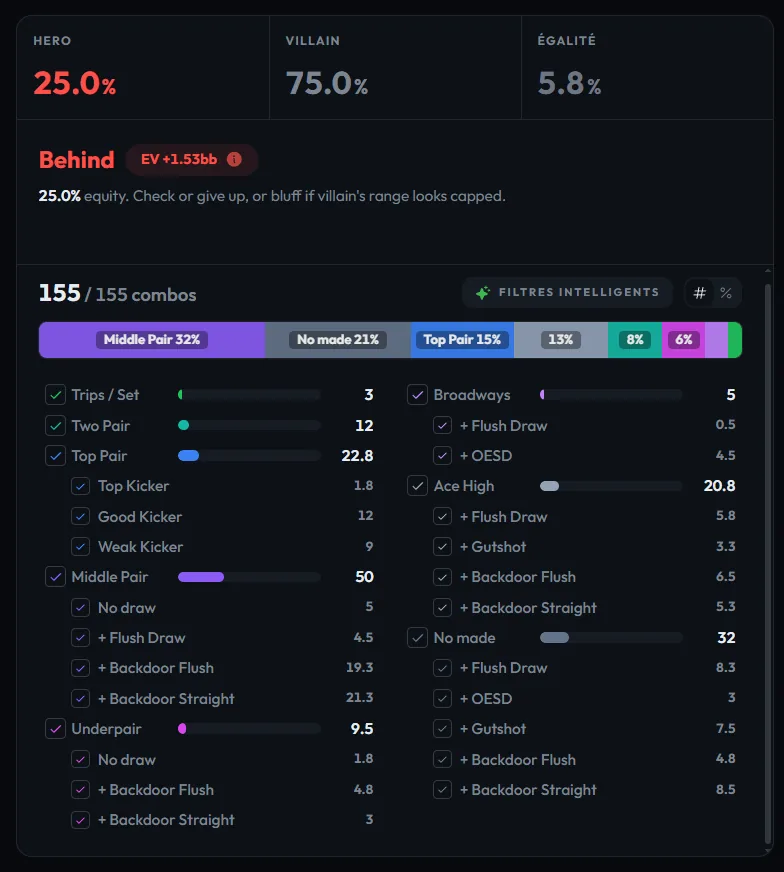
This breakdown is what makes exploitation possible, more so than the equity percentage. If 69% of the villain's flop range is weak hands, a bet generates a lot of fold equity. If it holds 40% strong hands, checking is often better even with decent equity.
A toggle switches between this detailed view and a macro view in three blocks (Value / Showdown / Air), useful for reading the structure at a glance.
Smart filters
Postflop, smart filters offer one-click selections directly on the matrix. The most useful one: keep only the hands that would continue against your bet. You get the villain's continuing range without rebuilding it by hand, which matters a lot when you are working through several hands in a row.
This is a Grinder feature.
The method that works
Start from the villain's preflop range for their position, then remove at each street whatever would not have taken that line. Two principles:
Be honest, not optimistic. The temptation is to give the villain the range that justifies your decision. That is the surest way to turn a study session into self-validation.
Model the player, not the theory. A fish who calls everything does not hold a reg's range. Player profiles exist precisely for this: build a "typical fish" range and a "tight reg" range once, then reuse them.
The shortcut
If you already have stats on the opponent (VPIP, PFR, 3-bet), they show up in My Hands and give you a far better basis than intuition. A 45% VPIP player and an 18% VPIP player do not open the same thing, and the gap between those two ranges is often worth more than ten minutes of thinking.