
The Lab
The heart of GrindLab: analyzing a hand street by street against the range you assign to the villain, with the equity, the verdict and the EV of every decision.
The Lab (“Lab a hand” in the menu) is GrindLab's central tool. You set up a hand, a board, the actions and the opponent's range, and it tells you whether your decision makes or loses money, and how much.
What the Lab computes
Equity. Your probability of winning against the range assigned to the villain, in three tiles: “Hero”, “Villain” and “Tie”. Preflop, a Monte Carlo simulation of 300,000 samples; postflop, an exact calculation over every card to come. The result updates with every change, with no “calculate” button.
The verdict. As soon as the street's actions are entered, the Lab judges the hero's decision in one line: “Good call”, “Tight fold”, “Value bet”, “Profitable semi-bluff”, “Thin value”, “Bad bet”… A badge gives the EV in big blinds; its tooltip breaks down the calculation.
The reasoning. A text quotes the spot's numbers: the equity you need to call (pot odds), the share of the range that folds and the MDF, or the equity you keep when the villain calls. It accounts for position, rake in cash games and bounties in tournaments.
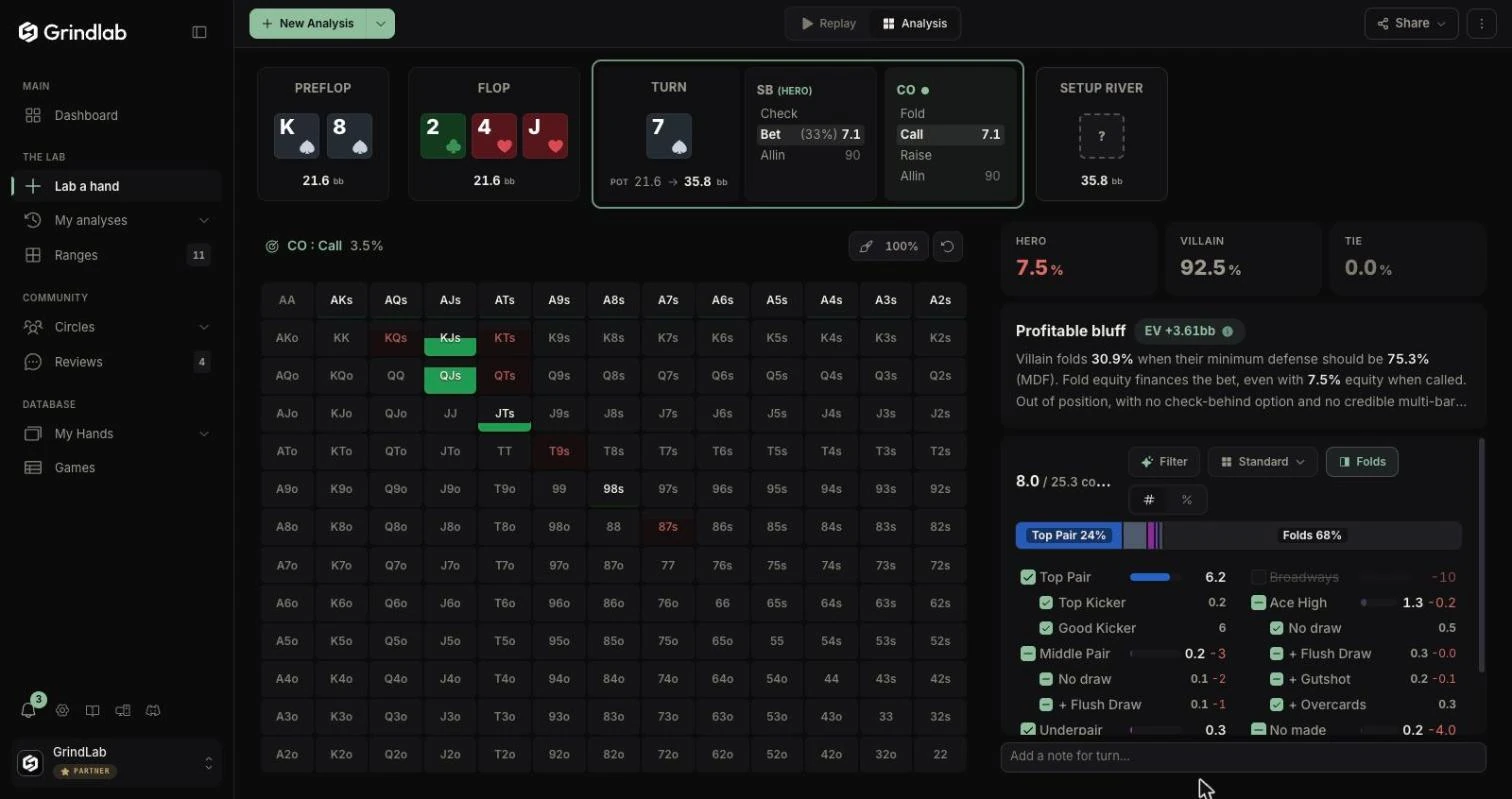
The verdict only exists heads-up: with three or more players, the Lab shows one equity tile per villain.
One limitation worth knowing
The analysis is only as good as the range you assign. Too tight, you overestimate your equity and fold profitable spots; too wide, you call losing spots. The engine is exact, the assumption is yours: that is why the villain's range deserves more attention than the calculation.
The four sub-chapters
- Analyze a hand: the walkthrough, from the hero's cards to the verdict
- The villain's range: 13×13 grid, weights, composition, smart filters
- Import a hand: paste a hand history or open a hand from the Tracker
- The replayer: replay the hand, then switch back to the analysis
Formats and setup
The Lab handles No-Limit Texas Hold'em, from 2 to 9 players. “Options” (the three dots at the top right), then “Configuration”, sets:
- the format: Cash game, MTT or Spin
- the number of players
- effective stacks, and the ante in MTT
- rake in cash games: room, region (France or international), “no flop, no drop” rule
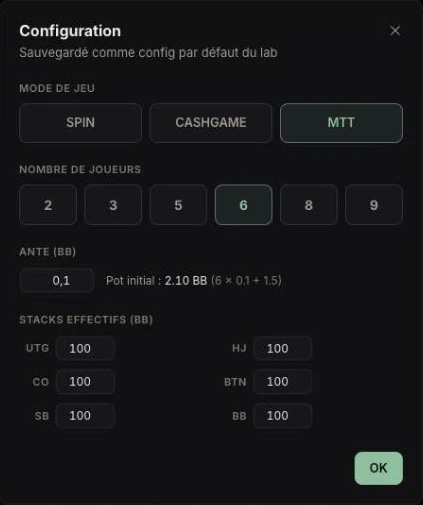
In MTT, the bounty of an all-in opponent is included when you call. There is no ICM model: the Lab reasons in chips and big blinds.
On the Free plan
- Always free: the hand, the board, the range, equity on every street, the “Standard” and “Force” displays.
- One hand a day, up to the flop: actions, verdict and EV, sizings, configuration, replay. The hand counts when you add actions; moving to the turn takes Grinder.
- Grinder only: postflop sub-filters, smart filters and the “Custom” display.
Past that, the gesture opens a window presenting Grinder, and nothing is erased. The Hand of the Day, opened from the Dashboard, stays complete for everyone: verdict, EV, sub-filters and filters. The full plan table is in Getting started.