
Ranges
Build, organize and reuse your ranges in the 13×13 editor: weights, tags, folders, player profiles, import and export.
Most players have a vague idea of what they open from each position. The Ranges editor forces you to decide, write the decision down and stick to it.
Building a range
Select the hands in the 13×13 matrix. Selected hands are highlighted.
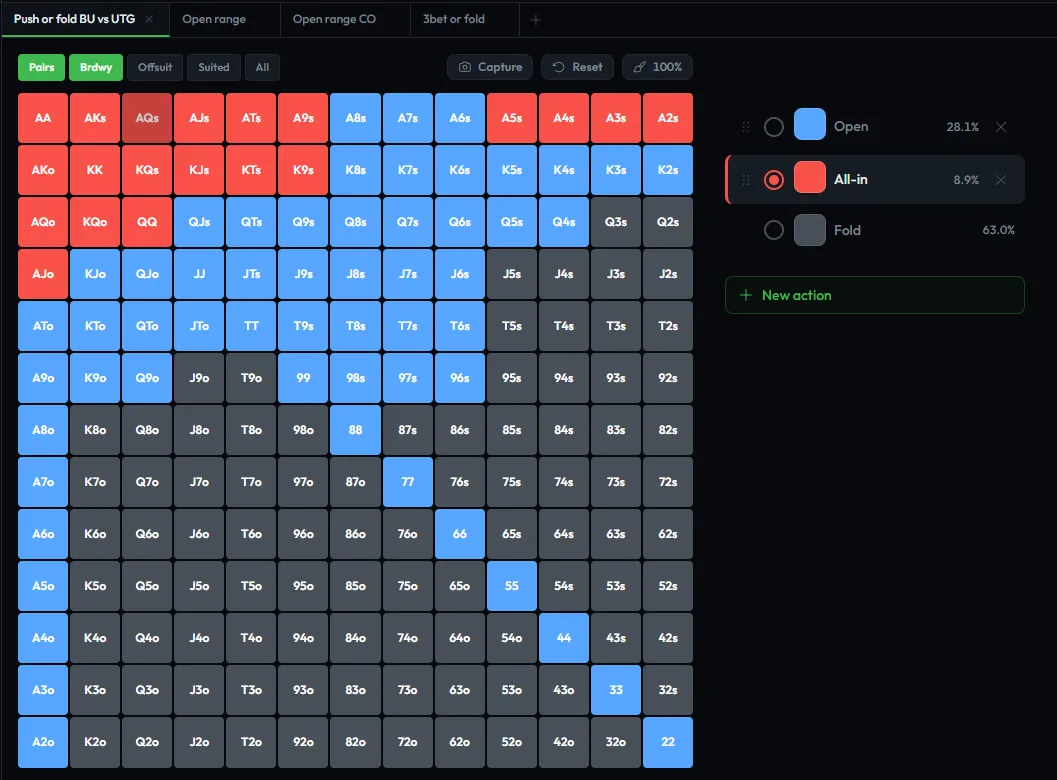
Assign weights when the frequency is not 100%. A5s opened every time on the button but half the time in the hijack is modelled as-is.
Tag the range with its metadata: position (BTN, CO, SB, BB, UTG, MP…), situation (open, vs 3-bet, vs limp), stack depth (25bb, 50bb, 100bb) and format (cash, MTT, SNG). Those tags are what keep the library usable once it grows.
Organizing the library
Ranges are filed by format and position, and you can see at a glance how many you have built for each spot. Folders group a project together, for example every big blind defense at 40bb.
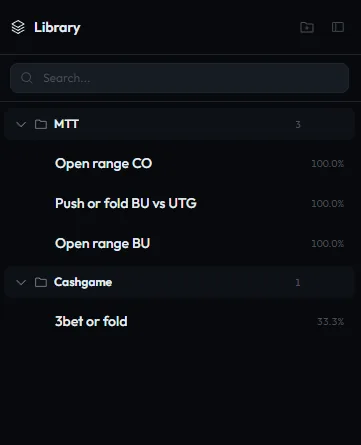
You work on several ranges side by side through tabs, like in a browser.
Player profiles
You can assign ranges to profiles: nit, reg, fish, or your own labels. This is the highest-return feature on the page, and the most overlooked.
Build a "typical fish" range and a "tight reg" range once. In the Lab you apply them in one click instead of rebuilding the villain's range for every analysis. Across a ten-hand review, it changes how long the exercise takes entirely.
Import and export
Ranges import and export as JSON and CSV. If you are coming from another tool, you can bring your existing work over instead of redoing it.
How many ranges?
The Free plan allows up to 5. The Grinder plan makes them unlimited.
That said, the limit that matters is not the plan's. Five well-built ranges you actually use beat forty ranges created on a Sunday and never reopened. Start with your open-raises at the depth you play most, and only add the next one when you hit a spot you have not covered.
Maintaining your ranges
Your ranges should move as your understanding does. A simple routine: one position a week, thirty minutes, cross-referenced with your History. If a hand keeps losing in a specific spot, it may not belong in the range. That routine is spelled out in Workflows.