Cash Game Poker Strategy: the Complete Guide to Winning at No Limit
The cash game is poker in its purest form. No payout structure, no rising blinds, no ICM: a chip is worth exactly what it costs, and every decision is judged by a single measure, expected value. It is also the format where the gap between an average player and a winning player is built most methodically, hand after hand, over tens of thousands of hands.
This guide is the pillar of our cash game series. It lays out the complete structure of a winning cash game strategy: preflop play by position, handling 3-bets, the blinds, postflop play at 100 big blinds, rake, bankroll, mindset and results tracking. Each section points to the detailed article, so you can dig into the area that costs you the most.
What makes cash games different
Three features shape the whole format.
Stacks are deep and constant. You usually sit with 100 big blinds and can rebuy at any time. Unlike in a tournament, your stack does not melt against the blinds: postflop play keeps all its importance, and turn and river decisions carry a lot of weight.
A chip is a chip. There is no survival premium. A call that is marginally profitable in chips is profitable in money. The ICM logic that drives tournaments does not exist here. That simplifies the maths: expected value in chips is your only judge.
Rake is taken from every pot. It is the structural cost of cash games. At low stakes it can absorb a huge share of a winning player's win rate. Ignoring rake means ignoring the largest expense line of your poker activity.
The consequence: cash games reward consistency, volume and discipline. A player who wins 5 bb/100 over 500,000 hands has a far more solid result than a player who hit one big pot in a single session.
The foundation: preflop by position
Preflop is the easiest part of the game to fix, and the one where most micro stakes players lose the most. A solid preflop strategy rests on a simple principle: the later you act, the more hands you can play.
Opening ranges
In 6-max, the reference ranges from our poker open ranges by position are as follows.
| Position | Share of hands opened | Standard sizing |
|---|---|---|
| UTG | 12 to 15% | 2.5 bb |
| HJ | 16 to 19% | 2.5 bb |
| CO | 24 to 28% | 2.5 bb |
| BTN | 42 to 50% | 2.2 to 2.5 bb |
| SB | 30 to 40% (raise only) | 3 bb |
The button opens almost three times as many hands as UTG, because it will play every flop in position and only has the two blinds behind it. How to build these ranges and adjust them to stack depth and opponents is covered in our guide on how to build poker ranges. To keep them in front of you, the preflop range charts are free to use, no account needed.
Why position is worth so much
Playing in position means seeing your opponent's action before you decide on every street. You control the pot size, you realise your equity better and you bluff more effectively. This is not a theoretical edge: over a large sample, the button is the most profitable seat for every winning player, and the blinds lose money for almost everyone.
The indicative win rates by position in our article on poker win rate in bb/100 make it clear: plus 20 to plus 40 bb/100 on the button for a good player, minus 15 to minus 5 bb/100 in the small blind, minus 20 to minus 10 bb/100 in the big blind. The goal in the blinds is not to win, it is to lose as little as possible.
Iso-raises, squeezes and limpers
At low stakes, limpers are everywhere. Over-limping behind them is almost always a mistake: you play a multiway pot without the initiative. The standard answer is the iso-raise, larger than a normal open, to isolate the weak player and play the pot in position. When an open is followed by one or more calls, the squeeze becomes a very profitable weapon, because the callers rarely hold a hand strong enough to continue.
3-bets: the preflop war
Once your opens are sound, the real difference is made on the raises that follow.
Making 3-bets
The 3-bet has two jobs: building a pot with your best hands and stealing the pot with hands that play poorly as a call. Reference frequencies vary by position and opponent.
| Spot | Against a tight player | Standard | Against a loose player |
|---|---|---|---|
| BTN vs CO | 10 to 12% | 14 to 16% | 18 to 20% and more |
| CO vs MP | 8 to 10% | 10 to 12% | 13 to 15% |
| SB vs BTN | 10 to 12% | 12 to 14% | 15 to 18% |
| BB vs BTN | 8 to 10% | 10 to 13% | 13 to 16% |
Outside the blinds, prefer a 3-bet or fold strategy to a wide calling strategy: calling an open out of position with players still behind you is one of the least profitable lines in the game.
Facing a 3-bet
This is the spot micro stakes players handle worst, usually by folding too much. The maths are clear. Take a cutoff open to 2.5 bb, a button 3-bet to 7.5 bb, and both blinds folding.
- If you call, you put in 5 more bb for a final pot of 16.5 bb: you need 30.3% equity for the call to be profitable at showdown.
- The button's 3-bet risks 7.5 bb to win the 4 bb already in the middle. As a pure bluff, it is profitable as soon as you fold more than 65.2% of the time.
As a theoretical reference, the opener should therefore continue with about 35% of their opening range so that every 3-bet bluff does not win automatically. In practice that figure is a ceiling rather than a target, because the 3-bettor also has equity when called. Continuing ranges, choosing between a call and a 4-bet, and adjustments by player type are in our guide on facing a 3-bet.
The blinds: limiting the damage
The blinds are the two positions where you pay before seeing your cards. You play one hand in three from them in 6-max, and they often decide the difference between an average and a good win rate.
The big blind
The big blind always gets the best price at the table, since part of its bet is already in the pot. Facing a button open to 2.5 bb, it pays 1.5 bb into a pot of 5.5 bb, about 27% required equity. So it must defend wide, but it plays every flop out of position. Defence frequencies by opener position, around 37% against UTG and 60% against the button, are covered in our guide on defending the big blind.
The small blind
The small blind is the worst seat in the game: it has already put in half a blind, plays out of position against everyone postflop and still has the big blind behind it. Most players lose far too much there by calling opens. Our article on small blind strategy explains why 3-bet or fold dominates against an open, and how to open when everyone has folded.
Blind versus blind
When everyone folds to the small blind, the spot changes completely: two very wide ranges collide, and aggression takes over. The choice between raise only and a mixed strategy with limps, big blind defence and postflop play are covered in our blind vs blind guide.
Postflop play at 100 big blinds
At 100 big blinds, postflop play accounts for most of the money that changes hands. Four ideas shape every decision.
Range advantage and texture
Before thinking about your hand, look at whom the board favours. An A-K-7 flop favours the preflop raiser, who has far more aces and kings in their range. A 7-6-5 flop often favours the big blind defender. This range advantage, combined with board texture, decides your c-bet frequency and sizing.
C-betting and sizing
The c-bet is not automatic. On dry boards that favour you, a small, frequent bet works. On connected boards, a larger and less frequent bet protects your range better. Choosing a size, from the small bet to the overbet, is developed in our guide to poker bet sizing.
Value and bluffs
At low stakes, most of your profit comes from value: betting thin to get called by worse hands. Micro stakes opponents call too much and bluff too little. The direct consequence: value bet more often and bigger, and bluff the river less. The complete framework is in our postflop poker strategy pillar.
Pot odds and equity
Every postflop call comes down to comparing your equity with the price you pay. Pot odds give you the threshold, equity tells you whether you reach it against your opponent's range. A call that ignores that threshold, repeated over thousands of hands, costs whole bb/100.
Rake: the invisible opponent
Rake is the commission the site takes from every pot. It is the only opponent you face in every hand, and it always wins.
What it really costs
Our poker rake comparison 2026 lists rates and caps for the main sites. What matters is not the advertised percentage, it is the cap: the maximum amount taken per pot. At micro stakes, the cap is reached very often and rake takes a huge share of each pot. That is the main reason NL2 win rates look high while paying little.
To put a figure on it for your stake and site, the poker rake calculator does the maths in seconds.
How to reduce its impact
- Choose your site for your stake. Caps vary a lot from one site to another and from one stake to another.
- Win pots before the flop. Regulated French sites apply No Flop No Drop, and many others do too: a pot won preflop is not raked. That is a strong argument for preflop aggression.
- Avoid marginal multiway pots. The bigger the pot, the more it is raked, up to the cap.
- Get some of the rake back. Loyalty programmes return part of the rake you pay. Our guide to poker rakeback explains how to value it without falling for the promotions.
Exploiting low stakes
Theory gives you a baseline, but the money at low stakes comes from opponents' mistakes. They are predictable: too many preflop calls, too many postflop calls, not enough bluffs, few 3-bet bluffs.
| Common imbalance | Profitable adjustment |
|---|---|
| Calls too much on the flop and turn | Fewer bluffs, more thin value |
| Rarely bluffs the river | Fold more against big river bets |
| 3-bets only the best hands | Fold more to their 3-bets, 4-bet bluff less |
| Folds too much to 3-bets | 3-bet wider, especially in position |
| Limps often | Iso-raise wide in position |
These adjustments are the core of our method to beat poker micro stakes. They assume you know which type of player you face: our article on poker player types gives the markers, and the one on GTO vs exploitative play explains how to choose between the two approaches.
Moving up in stakes
Moving up is the goal of most cash game players, and the place where many get burned. Three conditions must be met.
- An established win rate over a sufficient sample. With 10,000 hands, the margin of error is around 10 to 15 bb/100: you know almost nothing. Aim for several tens of thousands of hands.
- A bankroll sized for the new stake, not the old one.
- Specific preparation: players get more aggressive at each level, 3-bets become more frequent, marginal spots more common.
Our plan for moving up stakes from NL10 to NL50 sets out a realistic 12 to 18 month timeline, with bankroll thresholds and a study routine for each step.
Bankroll, variance and mindset
Bankroll
Cash games have the lowest variance of all poker formats, but it remains brutal. The reference rules from our guide to poker bankroll management:
| Profile | Buy-ins required | Example at NL50 |
|---|---|---|
| Recreational | 20 to 30 | €1,000 to €1,500 |
| Serious regular | 30 to 50 | €1,500 to €2,500 |
| Professional | 50 to 100 | €2,500 to €5,000 |
Variance
A player winning at 3 bb/100 can go through stretches of several tens of thousands of hands without winning. That is not an anomaly, it is the normal distribution of results. The poker variance calculator shows you, for your win rate and standard deviation, the realistic range of results over 100,000 hands and the size of the downswings to expect. The phenomenon is explained in detail in our article on poker variance.
Tilt
Most players' biggest leak is neither technical nor mathematical: it is the session that goes on after losing three stacks. Tilt turns a winning player into a losing one for a few hours, and those hours are enough to wipe out a week of profit. Our guide to tilt control in poker offers a concrete stop protocol.
Measure to improve: tracking your results
A cash game player who does not track results does not know whether they are winning. They think they know, because they remember their good sessions. Tracking replaces the impression with a measurement.
What to track
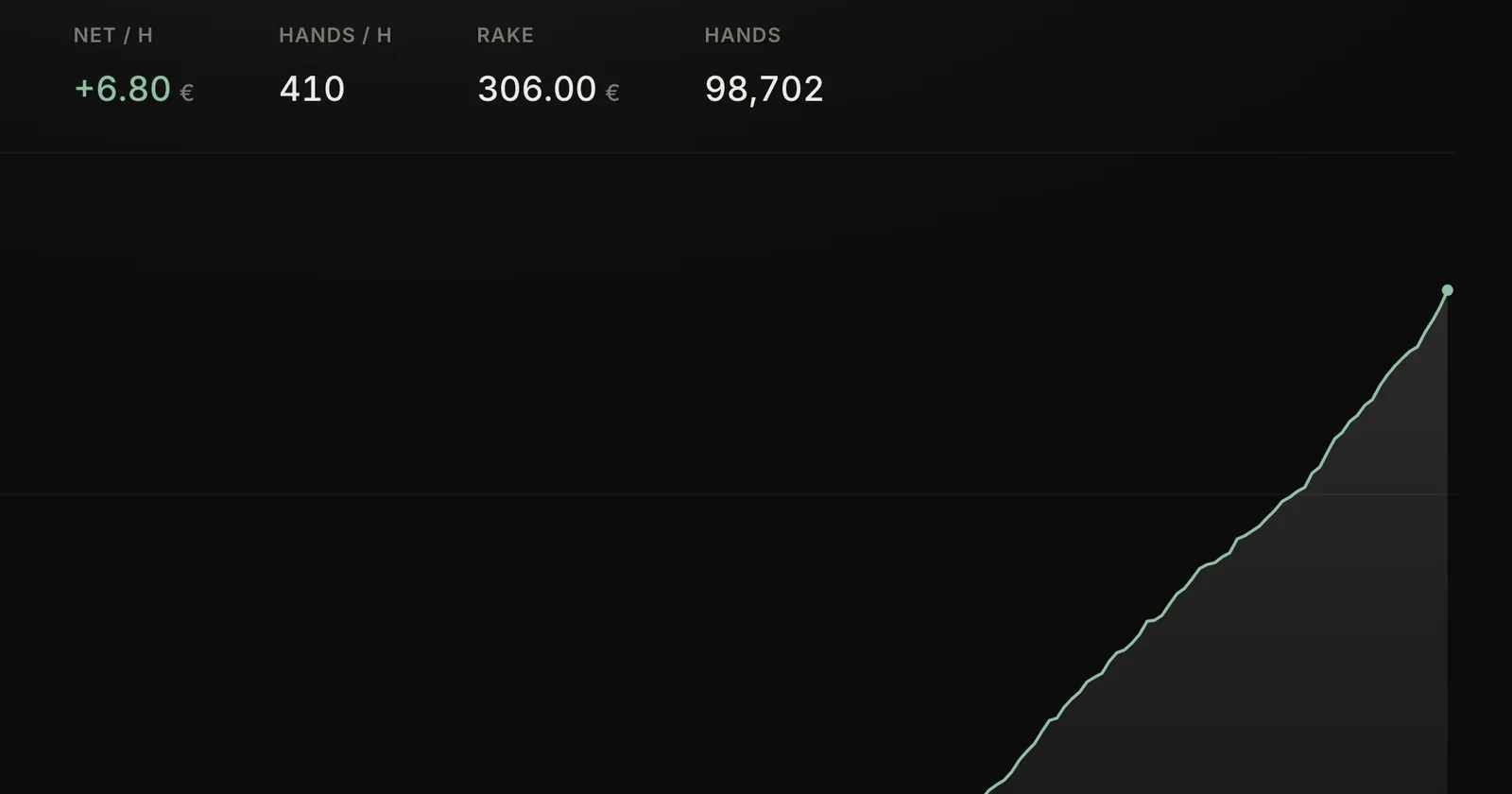
- Net and net EV. Net EV corrects for luck in all-ins. A net far below net EV for a long time signals bad luck, not a leak. Our article on poker winnings and EV curves explains how to read them.
- Win rate by position. It shows where you win and where you lose. A small blind losing far more than the reference almost always means too many calls.
- Showdown and non-showdown net. A very negative non-showdown net often signals play that is too passive, or too many folds against aggression.
- Attributed rake. Your actual share of the rake, pot by pot.
With GrindLab Tracker
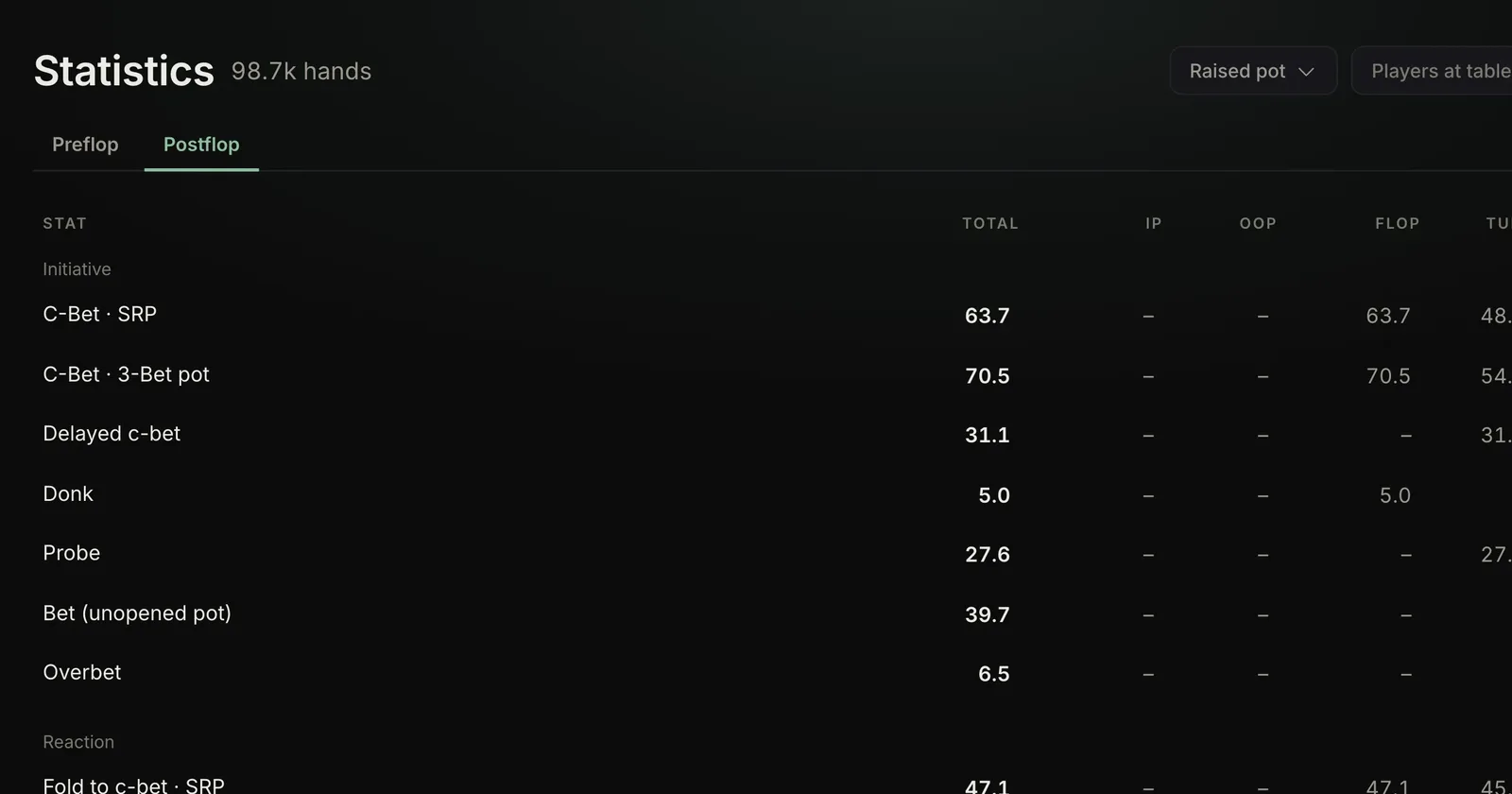
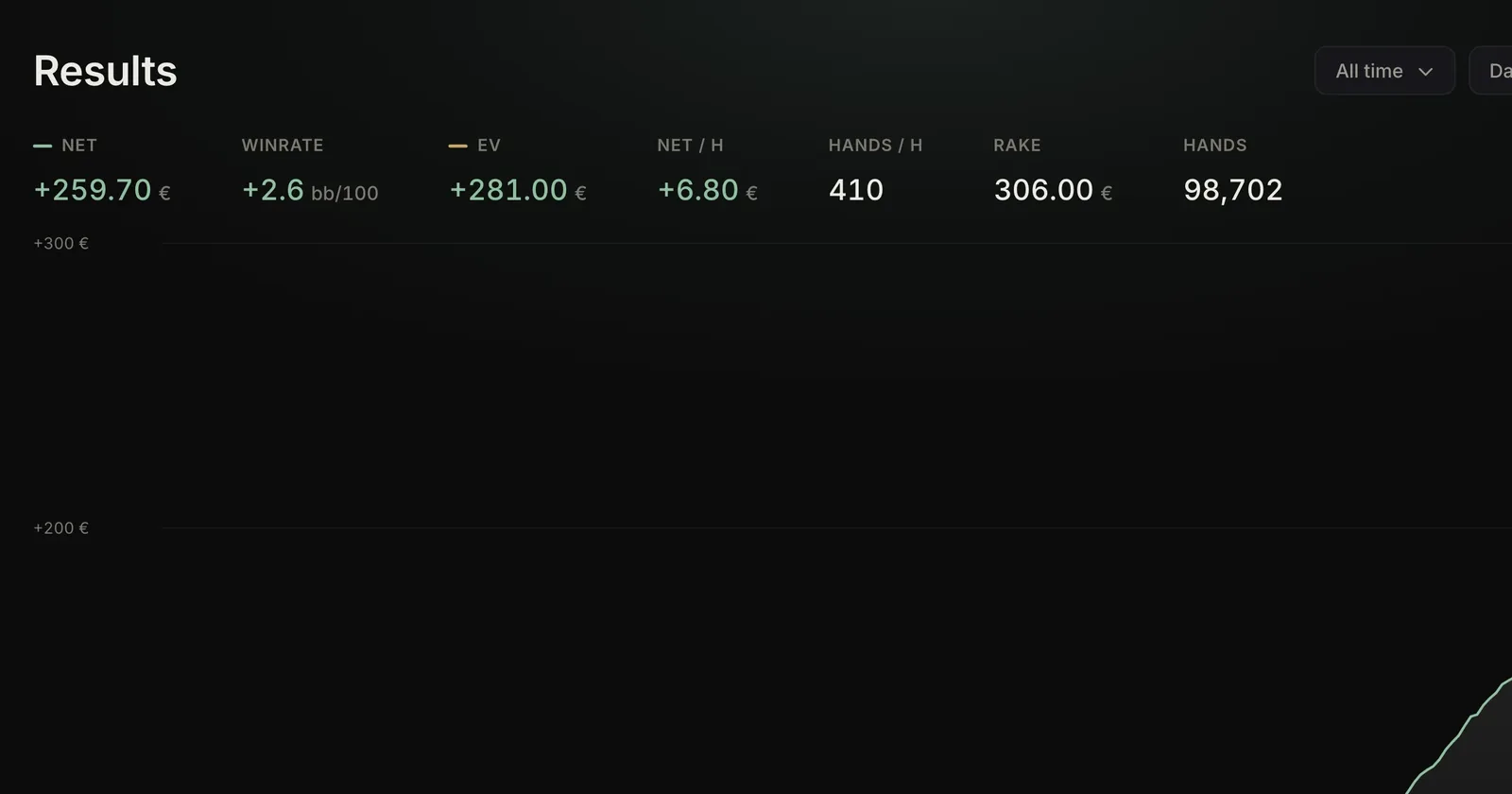
GrindLab Tracker is GrindLab's free desktop app for Windows and macOS. It watches the folder where your poker site saves your hands, imports them while you play and calculates your results, sessions and statistics. Details of its curves and key figures are in the Results chapter of the guide. The Free plan shows the last 30 days; full history, other units and the HUD (on Winamax) are part of the Grinder plan, described on the pricing page.
To go further on a specific hand, the GrindLab Lab lets you replay the spot street by street and measure your equity against the range you assign to your opponent. The Lab is not a solver: it helps you check your reasoning, not hand you a ready-made strategy.
An effective study routine
Volume alone is not enough. The players who improve fastest combine playing and reviewing.
- After each session, mark the doubtful hands. Not all of them: the ones where you hesitated or lost a big pot.
- Once a week, review them cold. Rebuild your opponent's range, work out your equity, compare it with the price you paid.
- Pick one topic per week. Big blind defence, 3-bet pots, river bluff catching: one topic worked in depth pays more than ten skimmed.
- Check the effect in your numbers. If you work on the small blind, look at its win rate a month later.
Our complete methods on how to study poker and how to review poker sessions detail this process.
The most expensive cash game mistakes
1. Calling too many opens out of position. Calling from the small blind, or from the cutoff against a UTG open, is one of the costliest leaks at low stakes.
2. Folding too much to 3-bets. An opponent who 3-bets wide banks an automatic profit if you only defend premium hands.
3. Bluffing players who call everything. At micro stakes, a river bluff against a player who never folds is money thrown away.
4. Ignoring rake. The same player can win on one site and lose on another with an identical strategy.
5. Moving up too soon. Over 10,000 hands, a good run proves nothing. Your bankroll must match the new stake.
6. Playing on tilt. A session dragged out after a big loss wipes out weeks of profit.
Key takeaways
- Cash games are played at 100 big blinds: postflop carries a lot of weight and every chip is worth its value in money.
- Preflop by position is the most profitable foundation to fix: the button opens almost half its hands, UTG under 15%.
- Against a 3-bet, defend enough: a 7.5 bb 3-bet bluff against a 2.5 bb open wins automatically if you fold more than 65% of the time.
- The blinds lose money for almost everyone: the goal is to limit losses.
- Rake is a structural cost: choose your site based on the caps at your stake.
- Track your results over a large sample with net EV and win rate by position.
To track your win rate, rake and sessions with no manual entry, download GrindLab Tracker for free: it imports your hands while you play, on Windows and macOS alike.