Postflop Poker Strategy: The Complete Guide
Preflop can be learned from charts. Postflop is played with principles. Once the flop is out, the number of situations explodes: different textures, different stack depths, different opponents. No chart covers it all. What covers it all is a method: knowing who is favored on this board, which bet size serves your goal, and which line tells a consistent story.
This guide is the entry point to our whole postflop series. Each section sums up one concept and sends you to the article that covers it in depth. Read it once from start to finish, then come back to it like a map: when a hand gave you trouble, identify the question (texture, sizing, line, multiway) and open the matching article.
What changes after the flop
Before the flop, everyone plays blind with two cards. After the flop, three community cards reshape the value of every hand. Pocket queens can be a very strong hand on 8♣ 4♦ 2♠, or a hand in real trouble on A♥ K♥ J♦. Four factors drive every postflop decision.
1. The range, not the hand. Your opponent is not playing "a hand", he is playing a set of possible hands, filtered by his preflop actions. Thinking in ranges is the first habit to build. If it does not come naturally yet, our guide on how to build poker ranges lays the groundwork.
2. Position. The player who acts last sees his opponent's action before deciding. He realizes his equity better, controls the pot size and bluffs more effectively. We cover this in our guide to poker positions.
3. Initiative. The last preflop aggressor reaches the flop with a stronger range on average. He is the one who most often wants to bet, hence the continuation bet.
4. Stack depth. The ratio between the effective stack and the pot, the SPR, decides whether you are playing for stacks or for a small pot. More on that below.
The foundations: equity, range advantage, nut advantage
Equity, the currency of postflop play
Equity is the share of the pot you win on average if the cards run out to the river. It is measured against a range, never against a single hand. If the concept is new to you, read poker equity explained first, then practice with the free poker equity calculator, which works without an account.
For draws, equity is counted in outs: a flush draw on the flop, with 9 outs, completes about 35% of the time over two cards. Compare that number with the pot odds to know whether a call is profitable.
Range advantage
You have a range advantage when your whole set of hands has more equity than your opponent's on a given board. On K♠ 7♦ 2♣, the button raiser has far more strong kings and overpairs than the big blind, who often 3-bet his best hands. On 7♥ 6♥ 5♦, it is the other way around: the big blind defends many small connected hands and hits this board more often.
Our article on range advantage in poker is entirely about this read, with examples by position matchup.
Nut advantage
Nut advantage is narrower: who holds more combinations of the very best hands (sets, straights, flushes)? A player can have the overall range advantage without the nut advantage. The distinction drives sizing: range advantage calls for frequent small bets, nut advantage allows large polarized bets, up to an overbet.
Counting those combinations precisely is the job of poker combinatorics, a skill you use on every street.
Theme 1: reading board texture
Texture describes how a board interacts with the ranges. It is the first thing to analyze on every flop, and our article on board texture in poker breaks it down in detail. Here is the minimum reading grid.
| Texture | Example | What follows |
|---|---|---|
| Dry, high card | K♠ 7♦ 2♣ | Clear edge for the raiser, frequent small c-bet |
| Dry, ace high | A♦ 8♣ 3♥ | Very good for the raiser, small size with almost the whole range |
| Paired | Q♣ Q♦ 5♠ | Few hands connect, frequent small c-bet |
| Connected, two-tone | J♥ T♥ 8♣ | Close equities, fewer bets, bigger size |
| Low and connected | 7♥ 6♥ 5♦ | Often favors the defender, the raiser checks a lot |
| Monotone | K♠ 9♠ 4♠ | Hand values shift, caution, small bets |
Three questions settle most spots. Does this board hit my range or his? How many turn cards change everything ("dynamic" board) or almost nothing ("static" board)? Do my medium-strength hands need protection?
A static board supports small, repeated bets. A dynamic board asks you to bet bigger with fewer hands, because equity swings a lot from one card to the next.
Theme 2: choosing your bet size
Sizing is not an execution detail, it is a strategic decision. The general rule: the more polarized your betting range (very strong hands and bluffs), the bigger the bet can be. The more merged it is (many medium hands), the smaller it should be. Our article on poker bet sizing develops this logic street by street.
Each bet size gives your opponent a precise price. These are the numbers to know by heart.
| Bet (% of pot) | Equity needed to call | Bluff break-even | Opponent's MDF |
|---|---|---|---|
| 25% | 16.7% | 20% | 80% |
| 33% | 19.9% | 24.8% | 75.2% |
| 50% | 25% | 33.3% | 66.7% |
| 75% | 30% | 42.9% | 57.1% |
| 100% | 33.3% | 50% | 50% |
| 150% | 37.5% | 60% | 40% |
| 200% | 40% | 66.7% | 33.3% |
The MDF column (minimum defense frequency) tells you how much of his range your opponent must continue with so that your bluffs are not automatically profitable. The concept is covered in MDF in poker, and you can test any bet size with the MDF calculator.
Small, medium, large: when to use which
- 25 to 33% of the pot: dry boards, strong range advantage, many hands betting. The goal is to get called by weak hands and fold out residual equity cheaply.
- 50 to 75% of the pot: middling boards, value hands that want calls from weaker pairs and draws.
- 100% of the pot and more: polarized range with the nut advantage, often on the turn or river. This is overbet territory.
Theme 3: postflop lines
A line is the sequence of actions you choose across several streets. Each line has a purpose. Here is the map of the main lines and the article dedicated to each.
The c-bet: keeping the aggression
The c-bet is the preflop raiser's bet on the flop. It is the most common line in poker, and also the one where players lose the most on autopilot. Its frequency and size depend directly on texture and range advantage. In tournaments, short stacks and ICM pressure change the parameters: see c-betting in tournaments.
The check-raise: taking the initiative back
The check-raise is the main weapon of the out-of-position player. It builds big pots with strong hands and puts pressure on with draws. Without a check-raise in your arsenal, opponents can bet any hand into your checks at no risk.
The donk bet: leading into the raiser
The donk bet means betting out of position into the previous street's aggressor. Long seen as a beginner mistake, it has a real role on boards that clearly favor the defender, or on turns that shift the range advantage.
The value bet: getting paid
The value bet is your main source of winnings. Betting for value means knowing which weaker hands can pay, and choosing the size that extracts the most from them. Thin value on the river often separates winning players from the rest.
The bluff and the semi-bluff: folding out better
Bluffing in poker is not improvised: it is built with the right blockers, a fitting size and a believable story. The semi-bluff, a bet with a draw, combines fold equity and real equity: it is the most profitable form of bluff on the flop and turn. To quantify what the bet earns when the opponent folds, see fold equity.
The triple barrel: going all the way
The triple barrel means betting flop, turn and river. It is the most expensive line when it fails and the most profitable when it is well chosen. River bluff selection relies heavily on blockers.
The slow play: hiding strength
Slow playing means checking or calling with a very strong hand to keep your opponent in the pot. Used well, it protects your checking range. Used badly, it gives free cards and costs whole pots.
The bluff catcher: calling at the right time
Facing a big river bet, many hands beat only bluffs. Knowing which ones to call, and how often, is the topic of our article on the bluff catcher. The answer depends on blockers, the opponent's size and the number of realistic bluffs in his range.
Summary table of lines
| Line | Main goal | Best context |
|---|---|---|
| Small c-bet | Exploit range advantage | Dry boards, in position |
| Large c-bet | Protection and polarization | Dynamic boards, nut advantage |
| Check-raise | Take the initiative back | Out of position, strong hands and draws |
| Donk bet | Use a favorable board | Low boards, turns that help the defender |
| Value bet | Get called by worse | Every street, especially the river |
| Semi-bluff | Fold equity plus equity | Draws on flop and turn |
| Triple barrel | Maximum pressure | Good blockers, scare cards |
| Slow play | Keep the opponent in | Dry boards, aggressive opponents |
| Bluff catch | Punish bluffs | Good blockers, opponent who overbluffs |
Theme 4: multiway pots
As soon as three or more players see the flop, almost everything changes. The chance that someone hit hard rises with each opponent, and fold equity collapses: if each opponent folds 60% of the time to your bet, two opponents fold together only about 36% of the time, three only 21.6%.
Core multiway principles:
- Bet less often, with a stronger range. Pure bluffs nearly disappear.
- Medium hands check more willingly: they are rarely strong enough for three streets of value against several ranges.
- Draws to the nuts gain value, because pots are bigger when they hit.
- The player squeezed in the middle (between a bettor and a player still to act) must call with a tighter range.
All of this is detailed, with numbers, in our article on multiway pots in poker.
SPR: the depth that decides commitment
SPR (stack-to-pot ratio) is computed on the flop: effective stack divided by pot size. It tells you how many bets are left to get stacks in.
Example at 100 big blinds in cash games: the button opens to 2.5bb, the big blind calls. The flop pot is 5.5bb with 97.5bb behind: SPR is about 18. In a 3-bet pot (cutoff opens to 2.5bb, button 3-bets to 8bb, cutoff calls), the pot is 17.5bb for 92bb behind: SPR of about 5.
With a low SPR, top pair good kicker can often commit its stack. With a high SPR, the same hand must control the pot. Our article on SPR in poker explains the thresholds and the SPR calculator does the math for you.
Defending against bets
Half of postflop play is reacting to your opponents' bets. Three tools structure your defense.
- Pot odds give the minimum equity to call. A half-pot bet requires 25% equity.
- MDF tells you how much of your range to defend so you are not exploited by systematic bluffs.
- Implied odds adjust that math when you can win more on later streets. See implied odds in poker and playing draws.
A warning: MDF is a theoretical benchmark. Against an opponent who almost never bluffs, defending at MDF loses money. That is the whole debate between GTO and exploitative play.
GTO or exploitation postflop?
Theory principles (range advantage, polarization, MDF) keep you from making big mistakes. They are your default strategy against an unknown opponent. But most players, especially at lower stakes, deviate clearly from equilibrium: some call too much, others fold too much, others bluff too little on the river.
Good postflop strategy therefore starts from theory and deviates when you have reliable information. Against a player who calls too much, value bet thinner and bluff less. Against a player who folds too much, raise your c-bet and barrel frequency. Poker player types help you classify opponents, and the GrindLab Tracker, free with no hand limit, measures their tendencies over real volume.
A four-step study method
Reading articles is not enough. Postflop skill grows by reviewing your own hands.
- Mark difficult hands during the session, without trying to analyze them on the spot.
- Replay them street by street and write down, at each decision, the question it raised: texture, sizing, line or multiway.
- Assign a realistic range to your opponent on each street, then measure your equity against it with the equity calculator.
- Compare with the reference article in this series, then write down the rule you take from it.
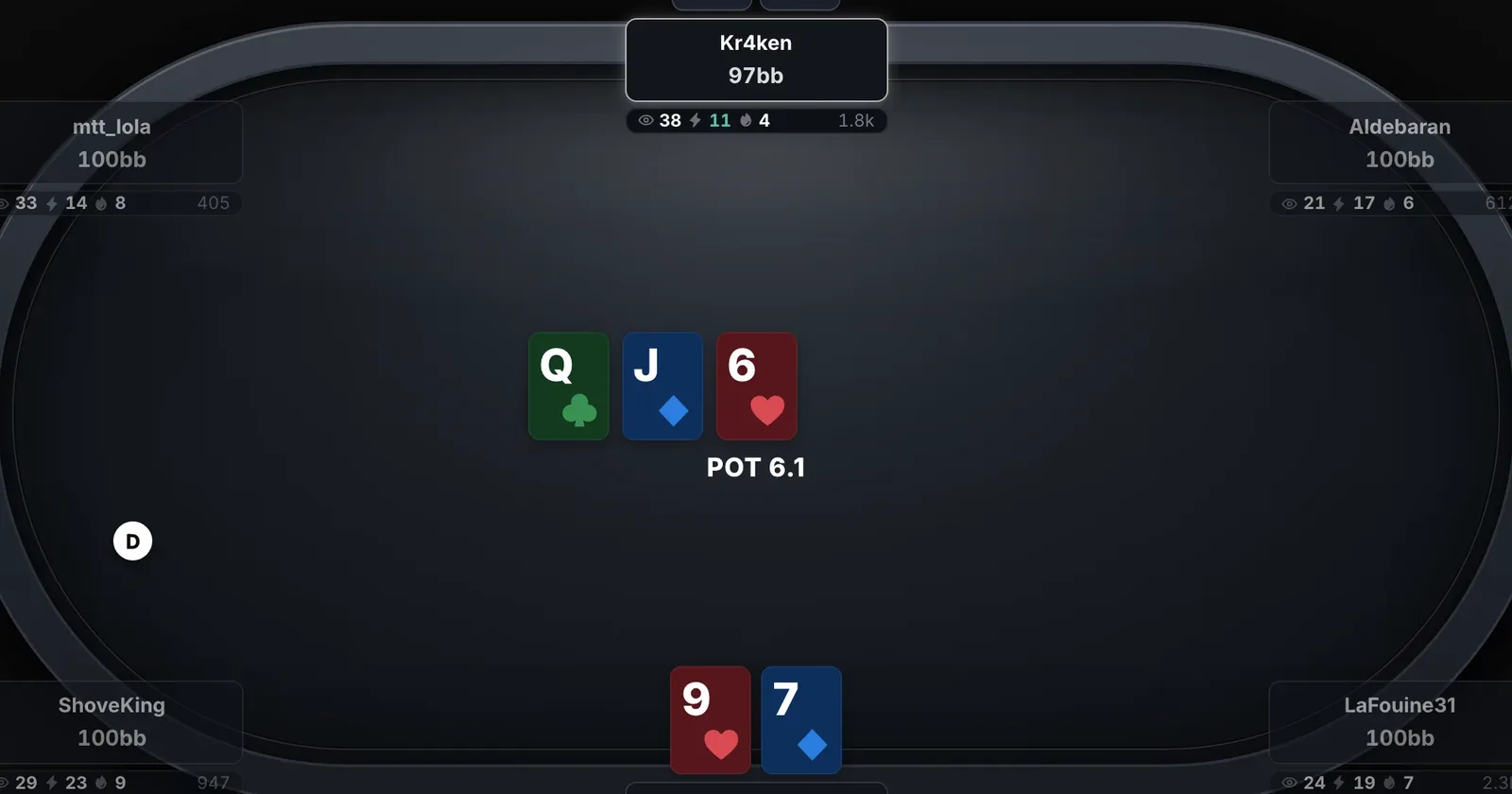
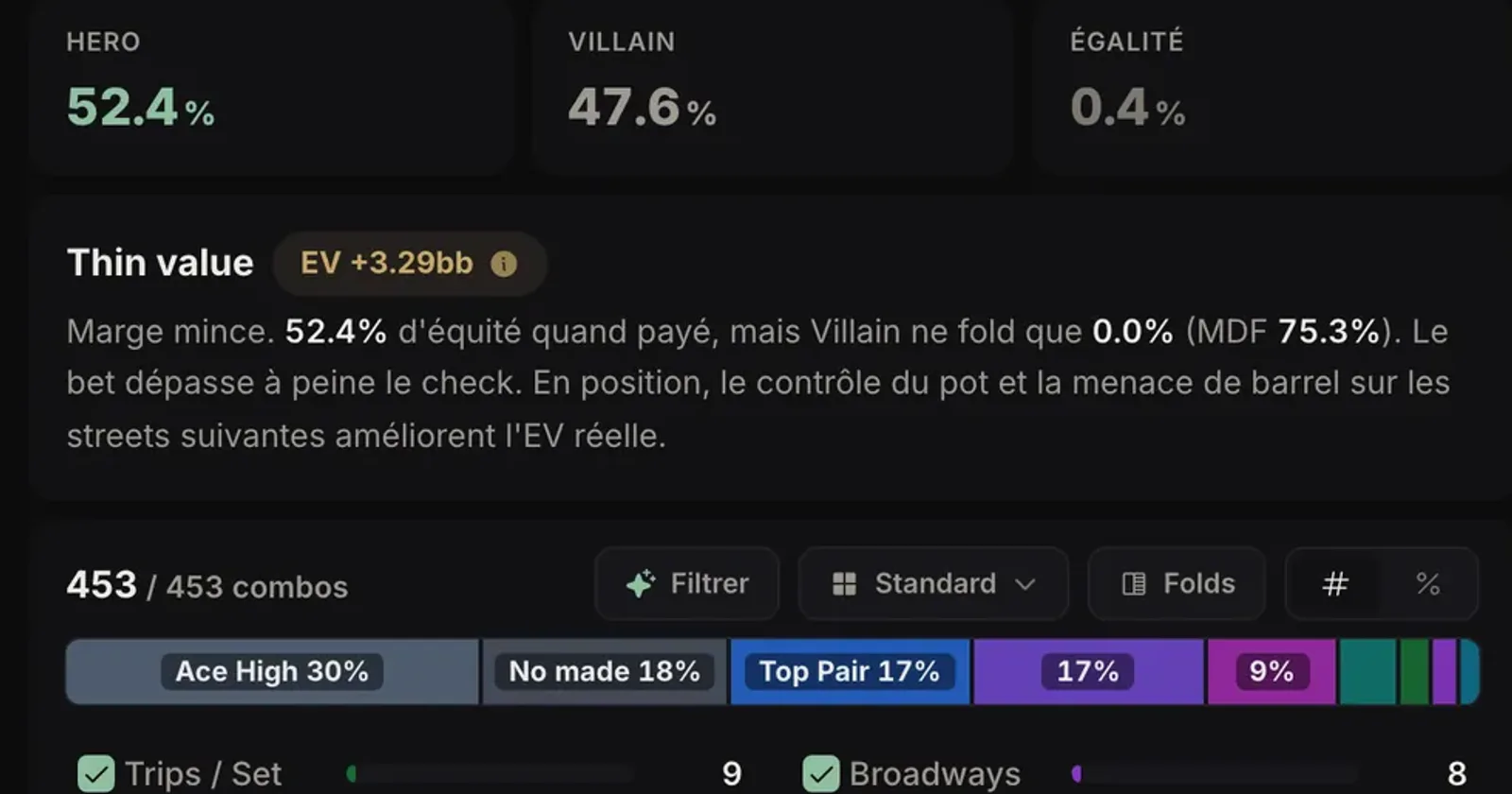
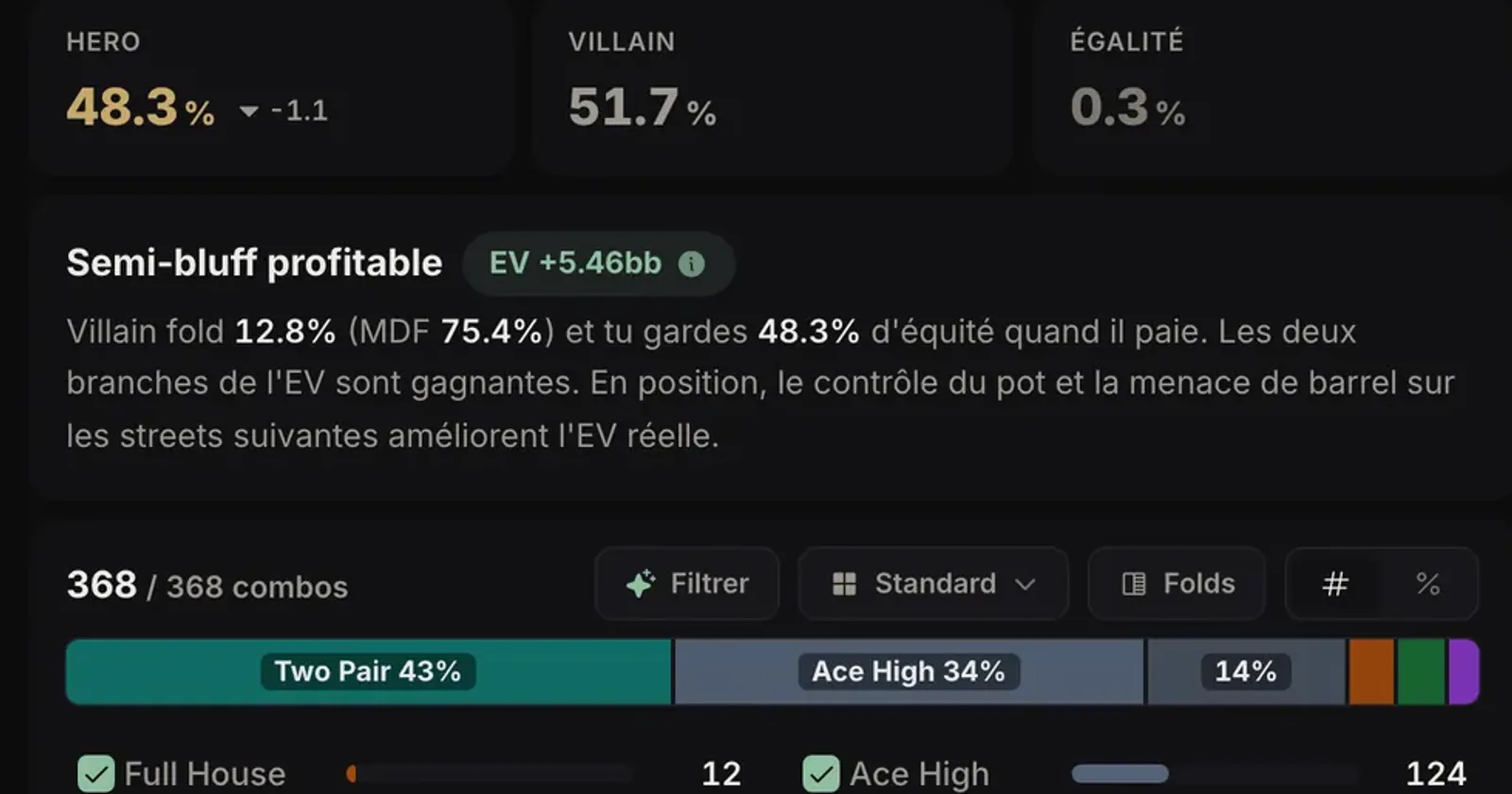
The GrindLab Lab automates this review: street-by-street analysis, hand-versus-range equity, villain ranges and the EV of each action. It is not a solver: it shows you the numbers of your real spot, and the decision is yours. To structure your sessions, see also how to review poker sessions.
Every article in the postflop series
| Theme | Article |
|---|---|
| Foundations | Range advantage, Combinatorics, Equity |
| Texture | Board texture |
| Sizing | Bet sizing, Overbet, SPR, MDF |
| Aggressive lines | C-bet, Tournament c-bet, Check-raise, Donk bet, Triple barrel |
| Value and bluffs | Value betting, Bluffing, Slow playing, Blockers |
| Defense | Bluff catcher, Pot odds, Implied odds |
| Multiway | Multiway pots |
Key takeaways
- Always think in ranges: your hand matters less than how both ranges interact with the board.
- Read the texture first: it drives betting frequency and sizing.
- Small sizes for range advantage on dry boards, large sizes for nut advantage and polarized ranges.
- Every line has a goal: value, protection, fold equity or pot control. A bet with no clear goal is usually a mistake.
- Multiway, bet less, bluff much less, protect your strong hands.
- Start from theory, then exploit your opponents' measured deviations.
- Review your difficult hands with numbers: equity versus range, odds, EV.