Value Betting in Poker: How to Get Paid
Spectacular bluffs make the highlight reels, but value bets fill bankrolls. Most of a winning player's profit comes from a simple idea: when you have the best hand, get paid by worse hands, as often and as much as possible.
This guide is part of our postflop poker strategy series. It explains how to recognize a value spot, choose the right size and go after thin value on the river.
Definition: what is a value bet?
A value bet is a bet made with the intention of getting called by weaker hands. A bluff, by contrast, aims to fold out stronger hands.
This definition rules out a very common type of beginner bet: the bet "to see where I'm at". If your bet folds out every weaker hand and only gets called by stronger ones, it earns nothing. It loses money every time it is called and wins nothing extra when your opponent folds.
The 50% rule
A value bet is profitable when, among the hands that call, you are ahead more than half the time. What matters is not your equity against your opponent's whole range, but your equity against the part of his range that continues.
River example: you hold K♠ Q♠ on K♦ 8♣ 5♥ 3♠ 2♦. Your opponent called the flop and the turn. Hands that will call a half-pot bet: weaker kings (KJ, KT, K9), eights and maybe some pocket pairs. Hands that beat you: AK, two pair, sets. If the calling hands are mostly weaker kings and eights, your bet is a clear value bet.
Why value betting is the core of your win rate
Look at the EV of a half-pot value bet into a pot of 100:
- If your opponent folds, you win 100, the same as checking (assuming you win at showdown too).
- If he calls with worse, you win 150 instead of 100: +50.
- If he calls with better, you lose 50 more than by checking: -50.
The bet therefore earns exactly when "called by worse" happens more often than "called by better". That is the 50% rule seen through expected value. You can run this math for your own spots with the poker EV calculator.
Players who forget to value bet leave that +50 on the table, hand after hand. At the end of a month, that is often the difference between a positive win rate and breaking even.
Choosing your value bet size
The best size maximizes (probability of a call) × (amount bet), accounting for the better hands that call too. There is no universal size. It all depends on the range that can call.
| Situation | Suggested size | Logic |
|---|---|---|
| Very strong hand, opponent with many medium hands | 75% to 100% of the pot, or an overbet | Medium hands often call a big bet |
| Strong hand, capped opponent (no nuts possible) | 66% to 100% of the pot | You do not fear a raise, maximize |
| Thin value on the river | 25% to 50% of the pot | Get calls from weak hands that would fold to a big bet |
| Very dynamic board, strong but vulnerable hand | 66% of the pot and up on flop and turn | Value and protection against draws |
| Calling station | Bigger than normal | He calls anyway, make him pay more |
The choice between small and large sizes is developed in our article on poker bet sizing. When your opponent is capped and you hold the nuts, an overbet can extract much more than a standard bet.
The trap of the small bet "to get paid"
Betting small with a very strong hand "to make sure you get paid" is a common mistake. If your opponent has a hand that would call a pot-sized bet, a one-third bet throws away two thirds of the possible value. A small size does not mean maximum value: it is for spots where the calling range shrinks sharply as the bet grows.
Thin value: the fine edge on the river
Thin value means value betting a medium hand that beats only a modest part of your opponent's range, but is still ahead more than half the time when called.
A thin value example
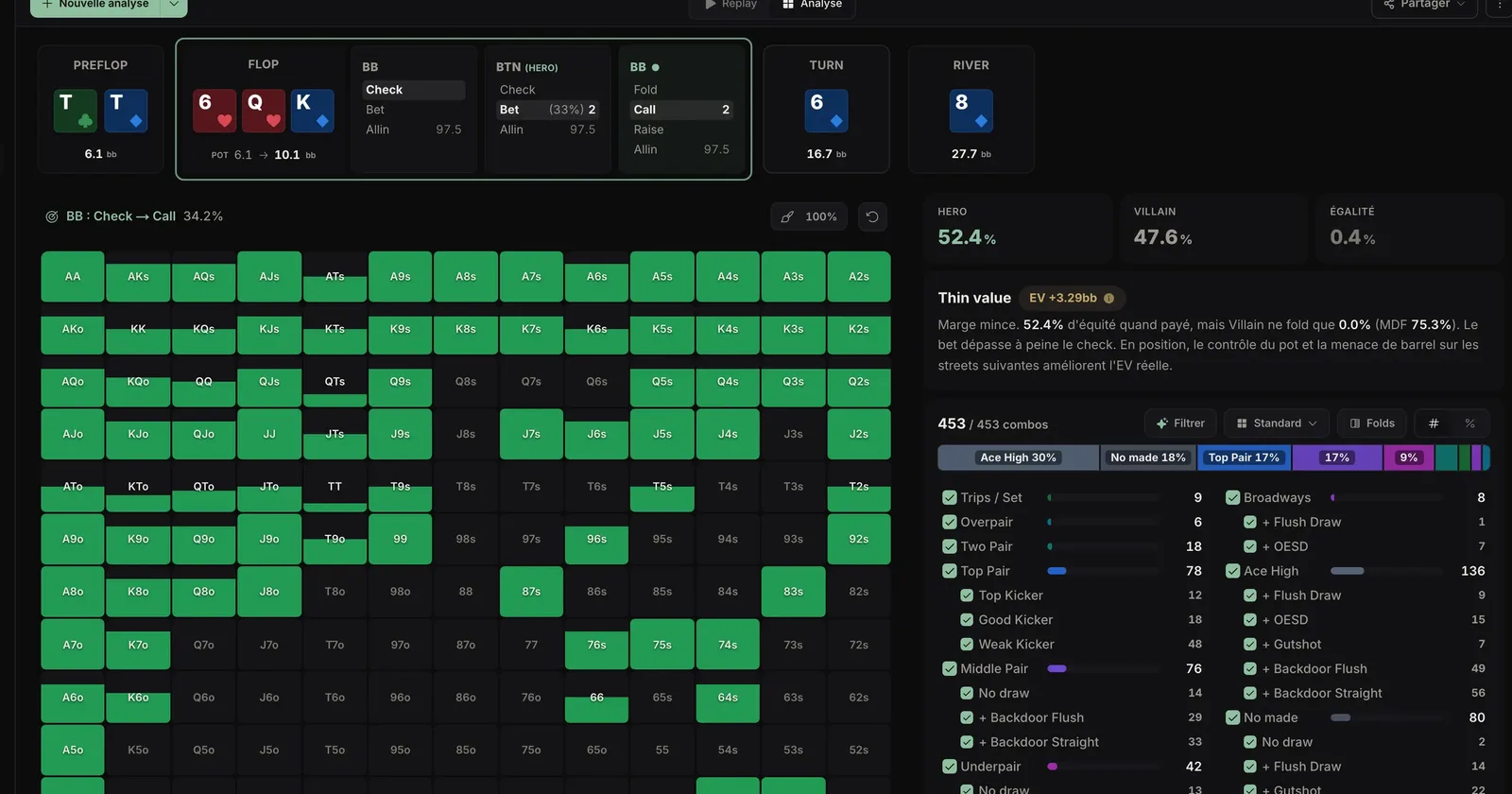
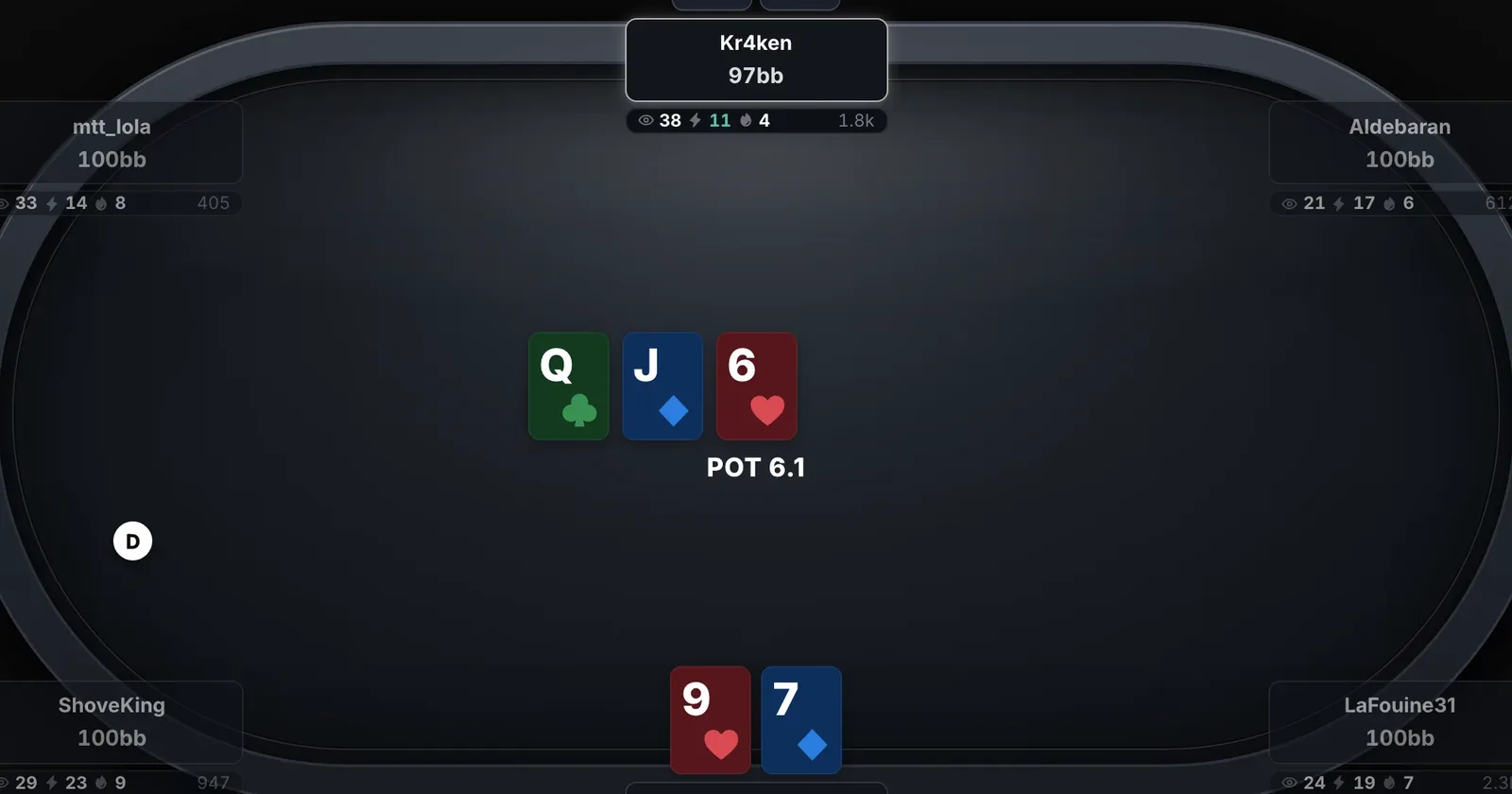
You are on the button with A♥ 9♥. The board runs out Q♣ 9♦ 6♠ 4♣ 2♥. The big blind check-called the flop, then checked the turn and the river. You have second pair, ace kicker.
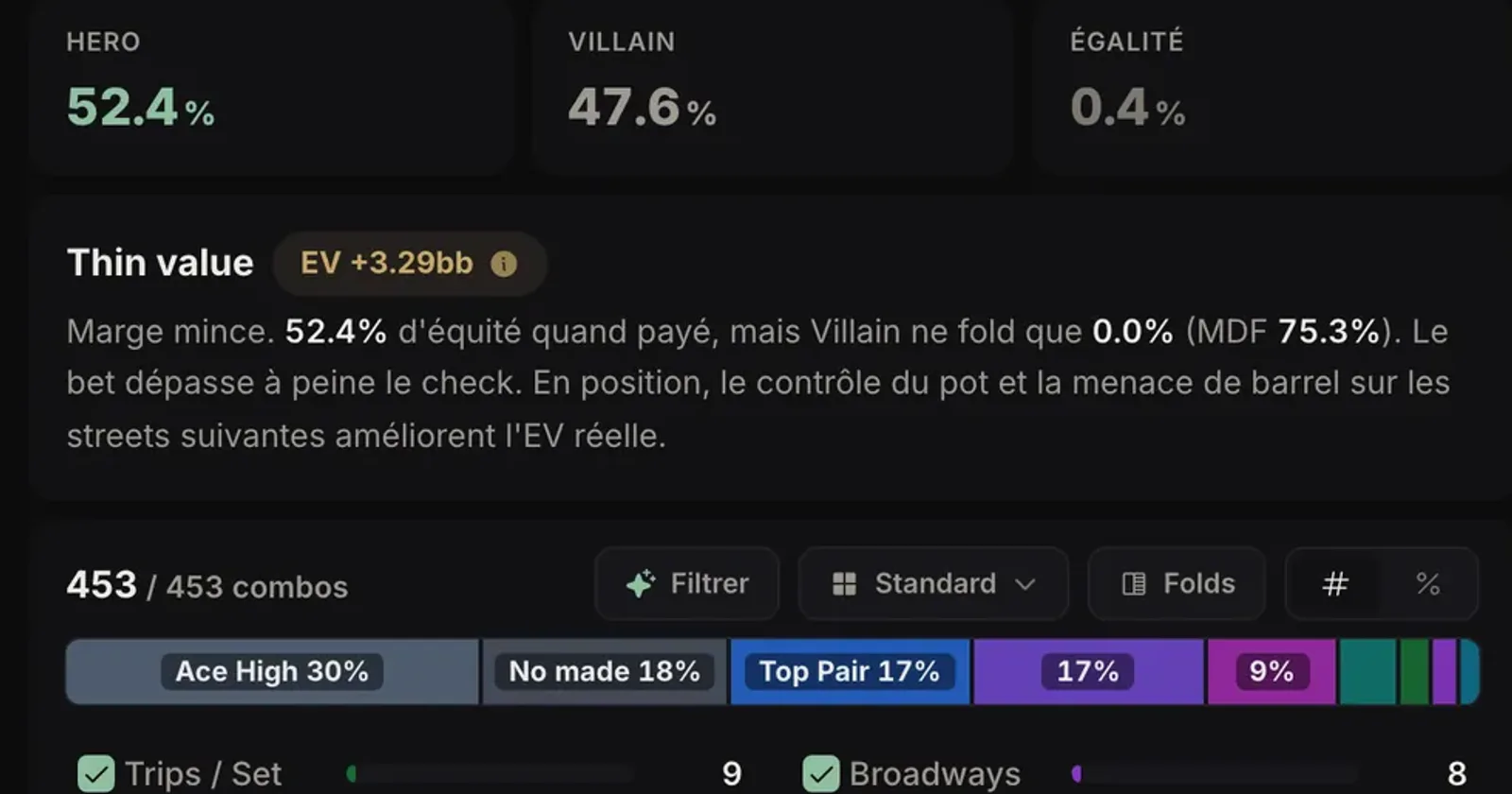
Which hands call a 33% pot bet? Weaker nines (T9, 98, 97), sixes, pocket pairs like 77 and 88, a few missed draws trying a light call. Which hands beat you and call? Queens, which the big blind would often have bet or check-raised earlier. Against this player, the thin value bet is profitable.
Conditions that favor thin value
- Your opponent is capped: his passive line rules out many strong hands.
- Your opponent calls too much: passive, curious profiles are the best targets.
- The board is static: few hands changed value on the turn and river.
- You are in position: you see his check before deciding.
Conditions against it
- Your opponent check-raises the river often: every raise costs you the bet.
- Your opponent's line is strong (flop check-raise, turn bet).
- The board completed many draws your opponent can hold.
Value betting street by street
On the flop
On the flop, value blends with protection. Top pair on a connected board wants calls from draws and weaker pairs before the turn changes everything. This is also where the c-bet and value overlap: on a dry board, a small frequent bet serves both your value hands and your bluffs.
On the turn
The turn is the street where the pot grows fastest. A second value bet must account for board texture: a card that completes a draw shrinks the calling range and grows the range that beats you.
On the river
On the river, there is no protection left: the bet is pure value or pure bluff. This is where the 50% math is cleanest, and where thin value pays the most.
Value betting and ranges: think like your opponent
To value bet well, picture your opponent's river range, then split it into three groups:
- Hands that call and that you beat: your profit.
- Hands that call and beat you: your cost.
- Hands that fold: neutral for a value bet.
Poker combinatorics lets you count each group in combinations. For example, with a king in your hand on a king-high board, only 2 kings remain in the deck: your opponent has only 8 combinations of KJ (2 kings × 4 jacks) instead of 16 before the flop. Blockers therefore matter for value too: holding a card your opponent needs to beat you raises the share of weaker hands in his range.
To measure your equity against the calling range, use the free poker equity calculator: enter your hand, the board and the calling range you have in mind.
Adjusting to your opponent
| Profile | Value adjustment |
|---|---|
| Calling station | Wider value, bigger sizes, almost no bluffs |
| Tight passive player | Tighter value, he only calls with strong hands |
| Aggressive player | Sometimes check strong hands to let him bluff |
| Balanced regular | Stay close to a theoretical strategy, mix sizes |
To classify your opponents, see poker player types. The GrindLab Tracker, free with no hand limit, helps you spot players who call the river too often.
The most expensive value mistakes
1. Checking the river out of fear. You have a decent hand, your opponent was passive, but you check "so you don't lose more". Against a capped range, that is lost value.
2. Betting too small with the nuts. A one-third bet with the nut straight against a player who showed a strong pair leaves a lot of chips on the table.
3. Value betting into a range that only calls with better. Against a very tight player who check-raised, your top pair is no longer a value hand.
4. Forgetting bluff catchers. Opponents often call with hands that beat only bluffs. Those hands are your value audience: understand them with our article on the bluff catcher.
5. Slow playing out of habit. Slow playing has its place, but betting remains the best option with most strong hands.
Key takeaways
- A value bet gets called by worse. If only better hands call, check.
- The 50% rule: you must be ahead more than half the time against the hands that call.
- Sizing depends on the calling range, not on habit: big against ranges full of medium hands, small for thin value.
- River thin value is a major source of profit against passive players.
- Adjust the width of your value range to the opponent: wider against calling stations, tighter against cautious players.
- Check your spots with numbers: equity against the calling range and EV of the bet.