Bluffing in Poker: When, How Much and With Which Hands
Bluffing fascinates because it looks like pure psychology. In reality, a good bluff is mostly arithmetic and range reading. It answers three questions: can your opponent fold, how often must the bet work to be profitable, and which hand in your range is the best candidate.
This article is part of our postflop poker strategy guide. It complements our article on value betting: together they form the two halves of a balanced betting range.
What is a bluff?
A bluff is a bet or raise made with a hand that usually loses when called, with the goal of folding out better hands. There are three kinds:
- The pure bluff: the hand has almost no equity. Example: a missed flush draw on the river.
- The semi-bluff: the hand is probably behind, but has outs to become the best. Example: a flush draw on the flop.
- The range bet: a small, frequent bet on a board that favors your range, with many hands that missed.
The math of bluffing: break-even frequency
A pure bluff is profitable if your opponent's fold frequency exceeds a simple threshold:
Break-even = bet ÷ (pot + bet)
| Bet (% of pot) | Bluff break-even |
|---|---|
| 33% | 24.8% |
| 50% | 33.3% |
| 66% | 39.8% |
| 75% | 42.9% |
| 100% | 50% |
| 150% | 60% |
| 200% | 66.7% |
Example: pot of 100, you bet 75. You risk 75 to win 100. The bluff breaks even if it works 75 / 175 = 42.9% of the time. Above that, it makes money.
These thresholds mirror MDF: if your opponent defends less than MDF, your bluffs become automatically profitable. You can test your own spots with the fold equity calculator.
The semi-bluff: fold equity plus equity
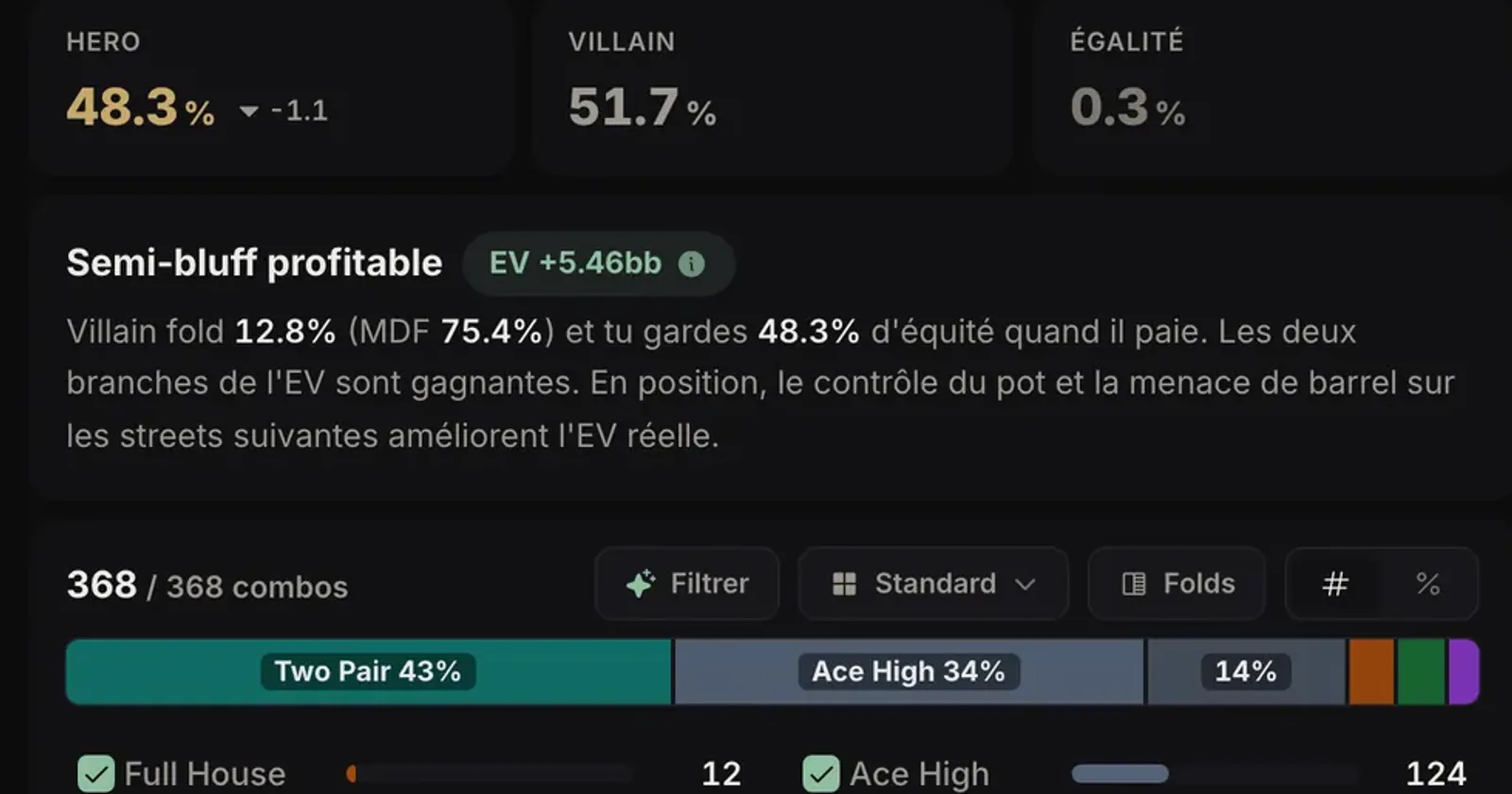
A semi-bluff wins two ways: your opponent folds, or he calls and you hit. That is why a semi-bluff can be profitable even if your opponent does not fold often enough for a pure bluff.
Flop example: you have a flush draw, about 35% equity over two cards (19.1% to hit right on the turn). Even if your bet only folds out 25% of the time, the remaining equity offsets much of the risk. Our article on fold equity in poker details the math, and playing draws explains when to semi-bluff rather than call.
When to bluff: favorable conditions
A bluff has a good chance to work when several of these conditions are met.
1. Your range is credible. Your line must be able to represent strong hands. If you called preflop and on the flop, a sudden river bet on a blank card is hard to believe.
2. Your opponent's range is weak or capped. An opponent who checked twice rarely has the nuts. His range holds many medium hands that can fold.
3. The card helps you. A card that completes draws or strengthens your range (an ace on a board where you have more aces than he does) is a good bluffing card. Range advantage shifts from street to street.
4. Your opponent can fold. Thinking players and regulars fold medium hands. Curious beginners and calling stations, much less.
5. You are heads-up. Multiway, fold equity collapses. See multiway pots.
Which hands to bluff with
Choosing your bluffs matters as much as deciding to bluff. The best candidates share three traits.
1. No showdown value
A hand that can win by checking (a medium pair, for example) does not need to bluff. Turning a hand that sometimes wins at showdown into a bluff often throws away your own equity. The best bluffs are hands that almost never win if you check.
2. Good blockers
Blockers are the cards in your hand that reduce your opponent's combinations. A good bluff blocks calling hands and does not block folding hands.
Example: on a river with three hearts on board, holding the ace of hearts without the flush makes it impossible for your opponent to have the nut flush. You block part of his strongest hands: that is a quality bluff.
3. Equity on later streets
On the flop and turn, prefer bluffs that keep outs: draws, overcards, backdoors. They can become strong hands and justify continued betting. This logic sits at the heart of the triple barrel.
The value-to-bluff ratio on the river
On the river, a solid betting range mixes value bets and bluffs. The theoretical ratio comes from the price you give your opponent: your bluffs should make up the same share as the equity he needs to call.
| Bet (% of pot) | Share of bluffs in the betting range | Value : bluff ratio |
|---|---|---|
| 33% | 19.9% | about 4 : 1 |
| 50% | 25% | 3 : 1 |
| 75% | 30% | about 2.3 : 1 |
| 100% | 33.3% | 2 : 1 |
| 200% | 40% | 1.5 : 1 |
The bigger the bet, the more bluffs you can include. That is why very polarized ranges (nuts or nothing) use large sizes and overbets.
These ratios are equilibrium benchmarks. Against a player who calls too much, cut your bluffs sharply. Against a player who folds too much, add more. That is the principle of exploitative play.
Bluffing street by street
On the flop: the range c-bet
The most common bluff in poker is the small c-bet on a dry board that favors the raiser. You bet much of your range, including hands that missed, because your opponent misses the flop most of the time.
On the turn: the second barrel
The turn is where bluffing costs the most chips and where you must be selective. Continue with your draws and with hands that gain equity on the card, give up bluffs with no outs. The turn is also the ideal street for an out-of-position semi-bluff check-raise (see the check-raise in poker).
On the river: the pure bluff
On the river, no more cards are coming. The bluff depends only on your opponent's fold frequency and the quality of your blockers.
A worked example: a river bluff
You are on the button with 8♥ 7♥. The board runs out K♥ T♥ 4♣ 2♠ 3♦: your flush draw missed, you have eight high. The pot is 20 big blinds and the big blind checks.
Step 1, the opponent's range. The big blind check-called the flop and checked the turn and river. His range is medium pairs (tens, fours, small pocket pairs), a few weak kings and missed draws. Strong hands would often have bet or check-raised earlier.
Step 2, the threshold. You consider a 15 big blind bet (75% of the pot). The bluff must work more than 15 / 35 = 42.9% of the time.
Step 3, the estimate. If roughly half his range is medium pairs and missed draws that fold to this bet, the bluff is profitable. Against a player who never folds a pair, it is not.
Step 4, bluff quality. Your hand has no showdown value: it almost never wins by checking. That is the ideal bluff profile, as long as your opponent can fold.
Opponents you should not bluff
| Profile | Why to avoid bluffing |
|---|---|
| Calling station | Calls with any pair, fold equity is minimal |
| Tilted player | Calls out of frustration, makes emotional decisions |
| Curious beginner | Wants to "see" your cards, does not think in ranges |
| Player already heavily invested | Feels committed to the pot, rarely folds |
By contrast, tight regulars and players who fold too much on the turn and river are your best targets. To spot those tendencies over real volume, the GrindLab Tracker tracks your opponents for free, and poker player types help you classify them.
The most common bluffing mistakes
1. Bluffing without a story. A river bet that matches no strong hand in your range is easy to call.
2. Bluffing with showdown value. Betting a medium pair "to fold out better" turns a hand that sometimes won into a hand that only wins when your opponent had worse.
3. Bluffing bad players too often. Bluffing is a tool against players who can fold.
4. Giving up too fast. A flop bluff with no plan for the turn is often wasted. Prepare the next step: which turn cards let you continue?
5. Ignoring pot size. Bluffing a big pot with a big bet needs a high success rate. Check the threshold before acting.
Key takeaways
- A pure bluff is profitable if it works more often than bet ÷ (pot + bet).
- The semi-bluff wins two ways and remains the most profitable bluff on the flop and turn.
- Choose bluffs with no showdown value, good blockers and, before the river, some equity.
- On the river, the value-to-bluff ratio depends on sizing: 2 : 1 for a pot-sized bet.
- Bluff players who can fold, not calling stations, and almost never multiway.
- Measure your fold equity and equity with the equity calculator before turning a hunch into a habit.