Poker Rakeback: How It Works, How to Calculate It and Maximise It
Every cash game pot you play pays a commission to the site: the rake. Over a year of grinding, that amount often exceeds your net winnings. Poker rakeback is the share of that commission the site gives back. For a regular, it is not an anecdotal bonus: it is a revenue line in its own right, one that can flip a result from losing to winning.
This article is part of our cash game strategy series. It explains how rakeback works, how to calculate it correctly, its real weight in your win rate and the traps of loyalty programmes. It deliberately gives no rates per site: programmes change often, and an outdated figure would lead you to a bad decision. The principles hold (state of play as of November 2026).
Rake and rakeback: the basics
Rake
In cash games, the site takes a percentage of every pot, limited by a cap that depends on the stake. Many sites, including all regulated French ones, apply No Flop No Drop: a pot that ends before the flop is not raked. In tournaments, the rake is included in the buy-in as an entry fee.
Rates and caps for the main sites are detailed in our poker rake comparison 2026. That comparison shows a key point: at the same stake, the cap difference between two sites can be worth several bb/100.
Rakeback
Rakeback is the refund of part of that rake. It almost always goes through the site's loyalty programme: you earn points based on the rake you pay, then those points convert into cash, tickets, bonuses or rewards. Some sites pay cash directly, others work with monthly tiers.
The effective rakeback rate is the value of what comes back to you, divided by the rake you paid. It is the only figure that matters, and rarely the one advertised.
How to calculate rakeback
The formula
Rakeback = rake paid × effective rakeback rate
The formula is simple. Both terms deserve attention.
Rake paid: which base?
There are several ways to count the rake that is yours.
| Method | Principle | Effect |
|---|---|---|
| Contributed | Your share of the rake, in proportion to what you put into each pot | The most common |
| Dealt | The pot's rake split equally between players who put money in | Favours passive players who put in little |
| Pots won | Rake counted only on the pots you win | Rare, favours big winners |
The proportional method is the most common base. It has a concrete consequence: an aggressive player who puts a lot of money into pots is attributed a larger share of the rake, and so generates more rakeback.
The effective rate: what your points are really worth
A programme can advertise a high rate, but if part of the reward comes as tickets you do not play or bonuses unlocked under conditions, the real value is lower. To estimate your effective rate:
- Add up what you actually received over a month: cash, plus the value of the tickets you really play.
- Divide by the rake you paid over the same month.
- Compare that figure with the advertised rate. The gap is often large.
A worked example
Take a hypothetical player who pays €300 of rake in a month with an effective rate of 20%. Their rakeback is worth €60. If they played 40,000 hands at NL10, that €60 is 600 big blinds of €0.10 spread over 400 hundreds of hands, so 1.5 bb/100 added to their win rate. For a player winning 3 bb/100 before rakeback, that raises their result by half.
The amounts are fictional, but the reasoning holds for any rate: always convert your rakeback into bb/100 to compare it with your win rate.
The weight of rakeback in your win rate
Win rate before and after rakeback
It is useful to track three figures separately:
- Your win rate net of rake, the one you see at the table: it measures your play after the commission.
- Rakeback in bb/100: your loyalty income.
- Total win rate: the sum of the two, which sets your real profitability.
A player at minus 1 bb/100 with 2 bb/100 of rakeback is profitable. But fragile: a change in the loyalty programme is enough to make them a losing player. A player at plus 4 bb/100 with the same rakeback is solid whatever the programme. Our article on poker win rate in bb/100 gives the benchmarks by stake to place your playing result.
Why micro stakes are the most affected
At micro stakes, the cap is reached very often and rake takes a much larger share of pots than at higher stakes. Rakeback therefore weighs proportionally more in a player's result. That is one reason our method to beat poker micro stakes puts so much emphasis on rake.
Rakeback is not a strategy
A common mistake is playing more tables, more hands or more pots just to generate rakeback. The maths almost always lose: every extra euro of rake only gives back a fraction of itself. Rakeback rewards the volume you would have played anyway, it does not justify worse decisions at the table.
The traps of loyalty programmes
Monthly tiers
Many programmes work with tiers: the more rake you generate in a month, the higher the rate. The trap is the end of the month, when you play beyond your form or your stake to reach the next tier. If reaching that tier makes you play tired or on tilt, the rakeback gain is quickly wiped out by losses at the table.
Rewards in tickets and bonuses
A tournament ticket is only worth its price if you would play that tournament anyway. A bonus unlocked in instalments as you play is only worth the part you actually unlock. Count these rewards at their real value to you, not their face value.
Temporary promotions
Leaderboards, weekly challenges, missions: these promotions can pay a lot, but they are often designed to make you play more than you planned. Assess them like the rest: what they really pay, divided by what they cost you in extra rake.
Programme changes
Sites regularly change their loyalty programmes. A profitability plan that relies entirely on rakeback is exposed to every change. That is the best reason to work on your playing win rate first.
Choosing a site: rake, rakeback and level
Rakeback is only one of three criteria for choosing a site.
| Criterion | What to look at |
|---|---|
| Rake | The cap at your stake, more than the advertised percentage |
| Rakeback | The effective rate at your real volume, not the maximum rate |
| Table level | The share of recreational players at your stake |
A site with low rake and weak tables can be more profitable than one with more generous rakeback. To compare the cost of rake at your stake, the poker rake calculator runs the numbers in seconds; then add your effective rakeback rate.
Pay less rake before getting it back
The best rakeback is the rake you never pay. Several strategic levers cut your bill directly, without changing sites.
- Win pots before the flop. With No Flop No Drop, a pot won preflop is not raked. An aggressive preflop strategy built on fold equity is therefore doubly profitable.
- Avoid marginal multiway pots. The more players, the bigger the pot, and the closer it gets to the cap.
- Play tight out of position. Marginal calls from the blinds create raked pots you often lose. Our article on small blind strategy gives a concrete example.
Tracking your rakeback with GrindLab Tracker
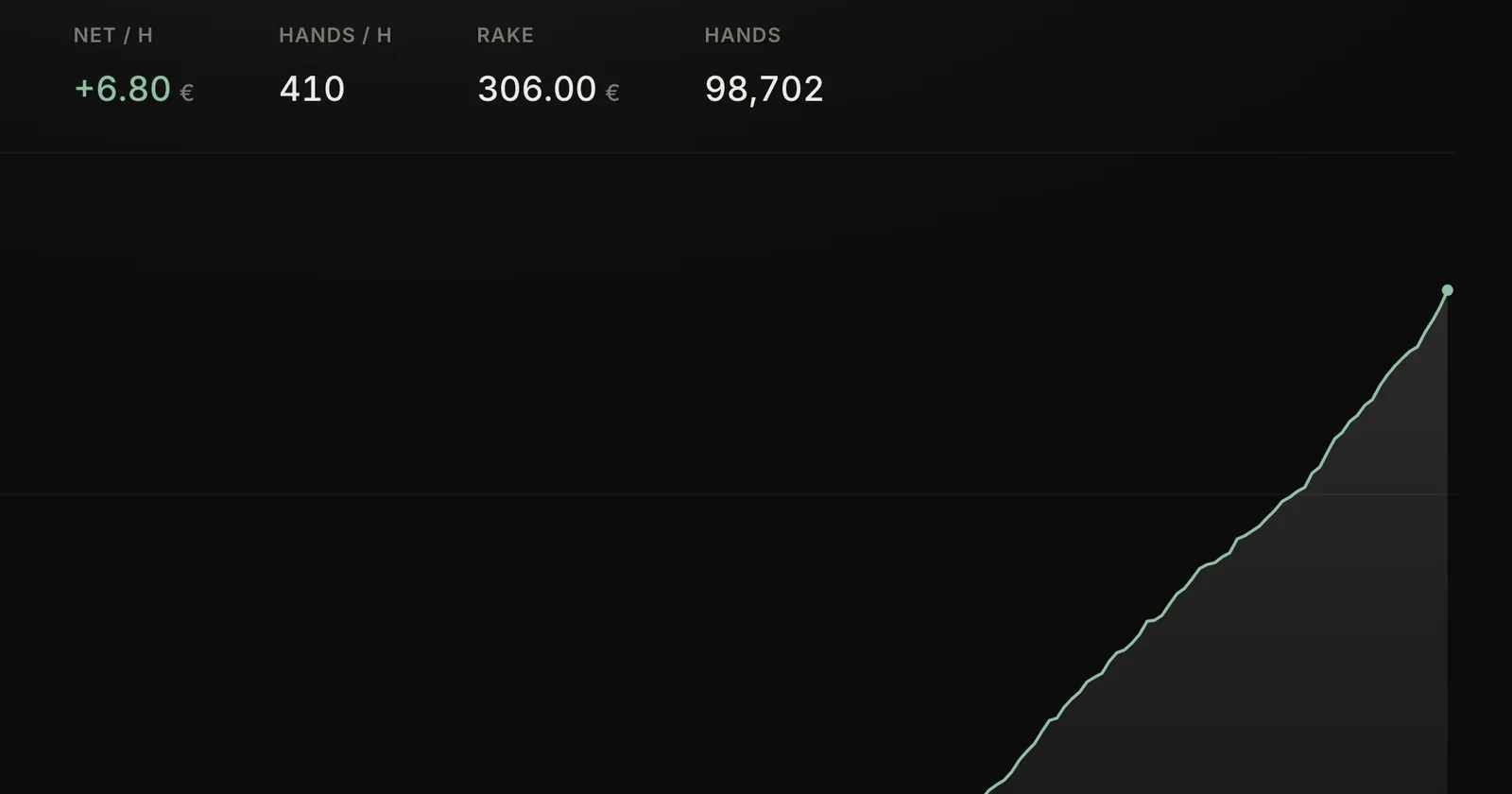
To know what rakeback really brings you, you need your actual rake, pot by pot. That is what GrindLab Tracker, GrindLab's free desktop app for Windows and macOS, does.
- The Tracker calculates your attributed rake: each pot's rake split in proportion to what each player put in, the base most sites use. A hand folded without investing anything attributes you none.
- Enter your rakeback rate in Settings › Tracker (one rate for cash, one for spins). It stays on your computer.
- The Tracker then shows your rakeback: in cash games, attributed rake multiplied by your rate; in spins, entry fees multiplied by your rate.
The figures and curves are detailed in the Results chapter of the GrindLab guide. The Free plan shows the last 30 days; other periods and units are part of the Grinder plan, presented on the pricing page.
The most frequent mistakes
1. Comparing advertised rates instead of effective rates. Only the value you actually receive counts.
2. Playing for the tier. The extra rake and degraded play often cost more than the tier pays.
3. Counting tickets at face value. A ticket you do not play is worth zero.
4. Choosing a site on rakeback alone. Rake and table level matter at least as much.
5. Confusing rakeback with win rate. A result that only holds thanks to rakeback is fragile.
Key takeaways
- Rakeback is the share of the rake the site gives back, usually through its loyalty programme.
- Calculate your effective rate: what you really receive, divided by the rake paid.
- The most common base is contributed rake, in proportion to your stake in each pot.
- Convert your rakeback into bb/100 to compare it with your win rate.
- Rakeback improves a result, it does not replace an edge at the table.
- The best lever remains paying less rake: preflop aggression, fewer marginal multiway pots.
To see your attributed rake and rakeback without a spreadsheet, download GrindLab Tracker for free and enter your rate in Settings › Tracker.