Facing a 3-Bet in Poker: Call, 4-Bet or Fold
You open from the cutoff, the button re-raises. It is one of the most frequent spots in cash games, and one of the worst played. The most common reaction when facing a 3-bet is to fold everything that is not premium, which hands the 3-bettor an automatic profit. The opposite mistake exists too: calling every 3-bet out of position with hands that never realise their equity.
This guide sets out the complete method: the maths of the spot, defence frequency, the effect of position, building calling and 4-bet ranges, and adjustments by opponent. It is part of our cash game strategy series.
The maths of the spot
What a call costs
Take the reference case: a cutoff open to 2.5 bb, a button 3-bet to 7.5 bb, both blinds fold.
- The pot before your decision: 0.5 + 1 + 2.5 + 7.5 = 11.5 bb.
- To call, you add 5 bb, for a final pot of 16.5 bb.
- Required equity: 5 / 16.5 = 30.3%.
That threshold is low. Against a reasonable 3-bet range, many hands reach it. The calculation, detailed in our article on pot odds, is still incomplete: it assumes you realise all of your equity, which is only true at showdown.
What a 3-bet bluff wins
Look at the spot from the button. Its 3-bet risks 7.5 bb to win the 4 bb already in the middle (both blinds and your open).
- Break-even point of a pure bluff: 7.5 / (7.5 + 4) = 65.2%.
- If you fold more often than that, any two cards become a profitable 3-bet.
As a theoretical reference, you should therefore continue with about 35% of your opening range. It is the logic of minimum defence frequency, the same as MDF postflop.
Why that figure is a ceiling
The 3-bettor is not purely bluffing: when you call, they have equity, and they often play the pot in position. Their bet does not need to make you fold 65% of the time to be profitable. In practice the right defence frequency is a little under 35%, but well above what most players defend, often around 20%.
What position changes
In position
Against a 3-bet from the blinds, you will play the flop in position. You realise your equity better, control the pot size and can bluff effectively. Calling becomes the main option with a large part of your continuing range: medium pairs, suited aces, suited broadways, strong suited connectors.
Out of position, your opponent 3-bets bigger. Example: a button open to 2.5 bb, a big blind 3-bet to 11 bb, the small blind folds. The button pays 8.5 bb into a final pot of 22.5 bb: it needs 37.8% equity. That is more expensive, but position partly makes up for it.
Out of position
When the 3-bettor is behind you (you open from the cutoff, the button 3-bets), you play every street out of position. Hands that rely on realising equity, such as small pairs or connectors, lose a lot of value. The strategy shifts towards a mix of 4-bets and folds, with calls kept for hands that play well postflop even out of position.
| Situation | Role of the call | Role of the 4-bet |
|---|---|---|
| You are in position | Main option | Value and a few bluffs |
| You are out of position | Solid hands only | More frequent, value and bluffs |
| Small blind facing a big blind 3-bet | Depends on depth | See the blind vs blind guide |
Building your defending range
Three buckets
Facing a 3-bet, every hand in your opening range goes into one of three boxes.
- 4-bet for value: hands that want more money in and can call off a stack. QQ+, AK, sometimes JJ and suited AQ against a very wide 3-bettor.
- Call: hands that play a 3-bet pot well but do not want to commit the whole stack. Medium pairs, suited aces and broadways, offsuit AQ, strong suited connectors in position.
- 4-bet bluff or fold: the rest. The best 4-bet bluff candidates hold an ace, for the blocker effect.
An example continuing range
For a cutoff open of around 26% of hands, about 345 combinations, facing a button 3-bet, one possible continuation:
| Action | Hands | Combinations |
|---|---|---|
| 4-bet value | QQ+, AK | 34 |
| 4-bet bluff | A5s, A4s | 8 |
| Call | JJ to 77, AQs, AJs, ATs, KQs, KJs, QJs, JTs, T9s, AQo | 74 |
| Total | 116, about 34% |
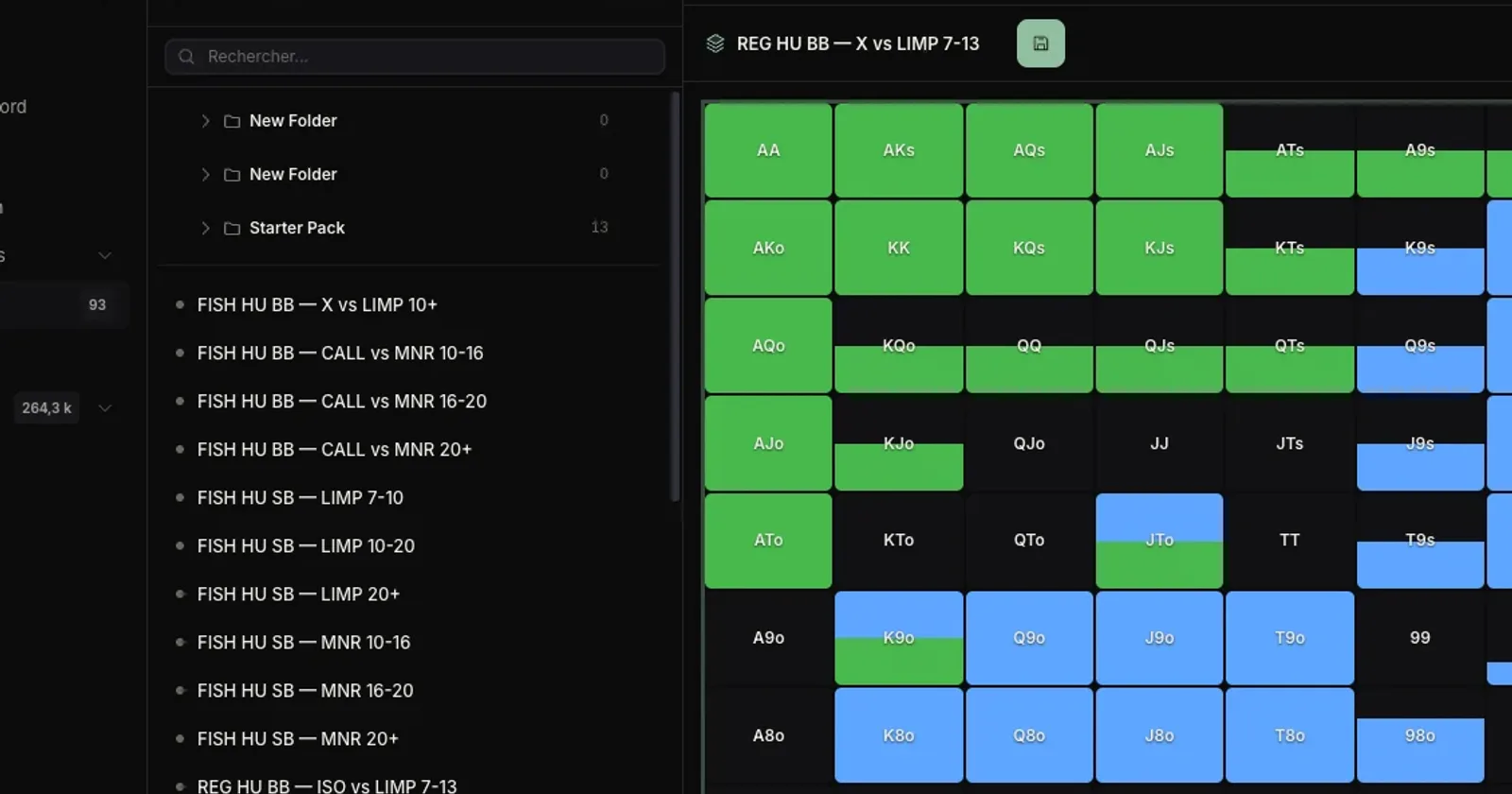
This table illustrates the logic, it is not a solver solution. Above all it shows the order of magnitude: defending about a third of your range means calling hands many players fold by reflex, such as 77 or T9s in position. The base ranges for each position are in our poker open ranges by position and in the preflop range charts, free and with no account needed.
Combinatorics and blockers
A reminder from poker combinatorics: a pair has 6 combinations, a suited hand 4, an offsuit hand 12, for 1,326 starting hands in total.
Holding an ace changes your opponent's range. With an ace in your hand, AA drops to 3 combinations instead of 6, and AK to 12 instead of 16. A hand like A5s therefore blocks a large share of the hands your opponent can call or raise your 4-bet with, while keeping equity when called. That is why weak suited aces are the classic 4-bet bluffs. The topic is developed in our article on poker blockers.
Adjusting to the opponent
The opponent's 3-bet frequency changes everything. A player who 3-bets 4% of hands does not have the same range as one who 3-bets 12%.
| 3-bettor profile | Adjustment |
|---|---|
| Very tight 3-bet (QQ+, AK) | Fold much more, call mostly pairs to hit a set, no 4-bet bluffs |
| Standard 3-bet | Apply a defence close to the reference |
| Wide 3-bet, many bluffs | Defend more, widen value 4-bets, add 4-bet bluffs |
| Wide 3-bet but often folds to 4-bets | 4-bet bluff more |
| Often calls 4-bets | Drop 4-bet bluffs, widen value 4-bets |
At micro stakes, 3-bets are usually much tighter than theory. Folding hands like AJ or KQ against the 3-bet of a player who almost never makes one is a correct adaptation, not weakness. Our method to beat poker micro stakes starts from that observation. Reference 3-bet frequencies by position are in our 3-bet poker guide.
Stack depth
The spot changes with depth.
- At 100 big blinds, the defence described here applies. A value 4-bet can call a 5-bet shove with QQ+ and AK.
- Deeper, hands that play well postflop (pairs, suited connectors) gain value as calls, and 4-bet bluffs get more expensive.
- Shorter, around 40 big blinds, the 4-bet often becomes a shove and calling loses its appeal, since little postflop play remains.
Playing the 3-bet pot after the flop
A 3-bet pot is played with a low SPR. After a called 7.5 bb 3-bet at 100 big blinds, 92.5 bb remain for a 16.5 bb pot: an SPR of about 5.6. After a called 11 bb 3-bet, 89 bb remain for 22.5 bb: about 4.
Consequences:
- Top pair good kicker often plays for stacks. At that SPR, it is rarely possible to play it small.
- Medium hands must control the pot. Second pair does not want to commit a stack over three streets.
- The 3-bettor has the range advantage on high boards. On A-K-x, they have far more aces and kings than you. On low, connected boards, your calling range, rich in medium pairs and suited connectors, takes the advantage back.
These principles tie in with our postflop poker strategy pillar.
The special case of the blinds
When you open from the small blind and the big blind 3-bets you, you are out of position against an opponent who defends wide. That spot follows its own rules, detailed in our blind vs blind guide. For building your ranges as a whole, our guide on how to build poker ranges remains the reference.
Checking your defence
Leaks against 3-bets are easy to spot once you look at your numbers.
- Fold to 3-bet: above 70%, you are very likely exploitable.
- Results in 3-bet pots: pots you call and then consistently lose point to calls with hands that do not realise their equity.
GrindLab Tracker, free on Windows and macOS, imports your hands automatically and calculates your preflop statistics. For a specific hand, the GrindLab Lab lets you set the 3-bet range you assign to your opponent and measure your equity against it. The Lab is not a solver: it checks your reasoning, it does not hand you a ready-made strategy.
Classic mistakes
1. Folding everything except premium hands. The 3-bettor banks an automatic profit.
2. Calling out of position with small pairs. They rarely hit a set and realise their equity poorly.
3. 4-bet bluffing a player who calls everything. A bluff needs an opponent who folds.
4. Ignoring the opponent's 3-bet frequency. The same hand can be a call against one player and a fold against another.
5. Playing the 3-bet pot like a single-raised pot. The low SPR changes the value of top pairs and medium hands.
Key takeaways
- Facing a 7.5 bb 3-bet on a 2.5 bb open, a call needs 30.3% equity.
- A 3-bet bluff wins automatically if you fold more than 65% of the time: defend about a third of your range.
- In position, calling dominates; out of position, the strategy leans towards 4-bet or fold.
- Weak suited aces are the best 4-bet bluffs, thanks to blockers.
- Adapt everything to the opponent's 3-bet frequency.
To keep consistent ranges by position in front of you, use the preflop range charts, free and with no account needed.