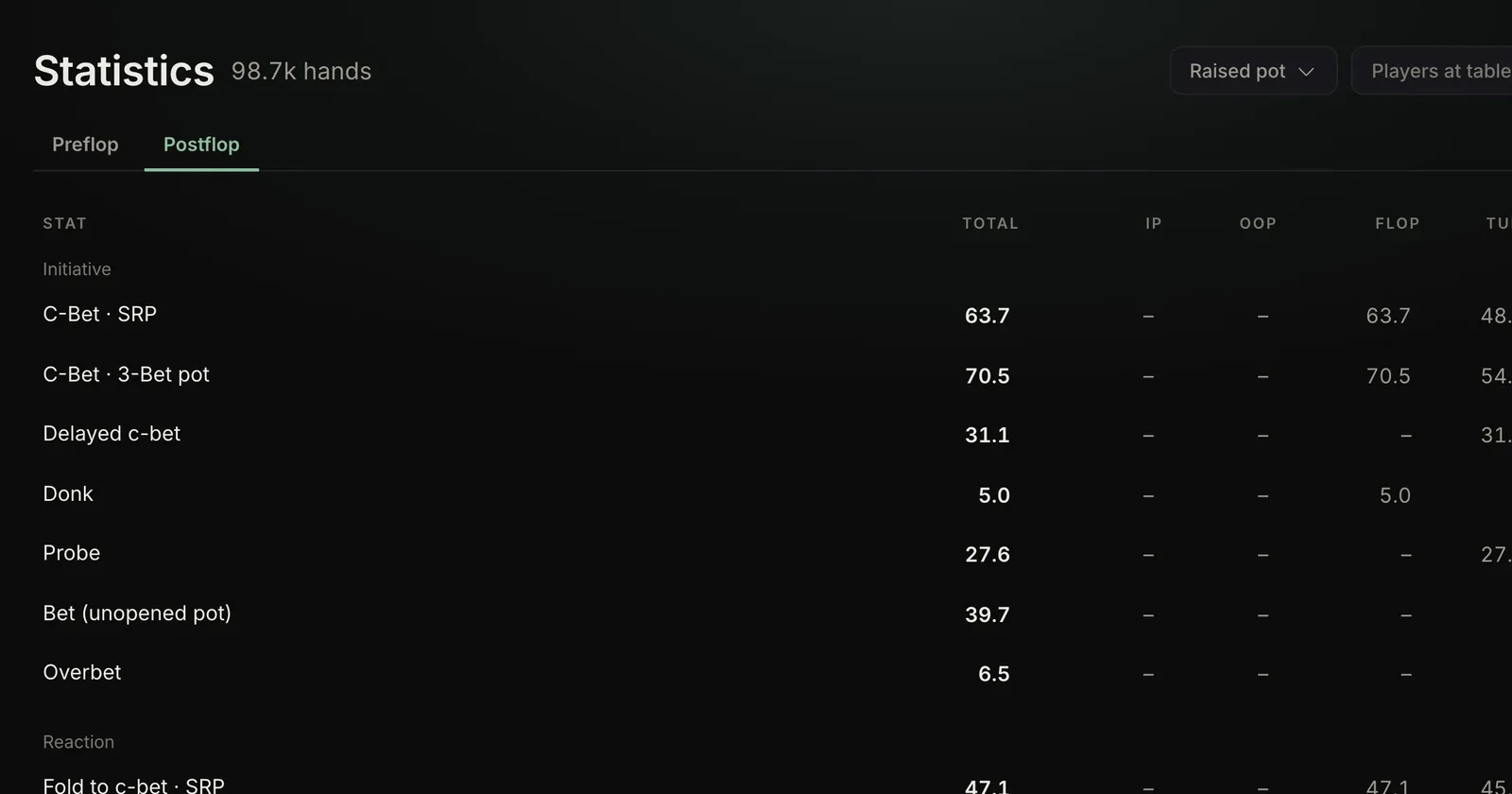
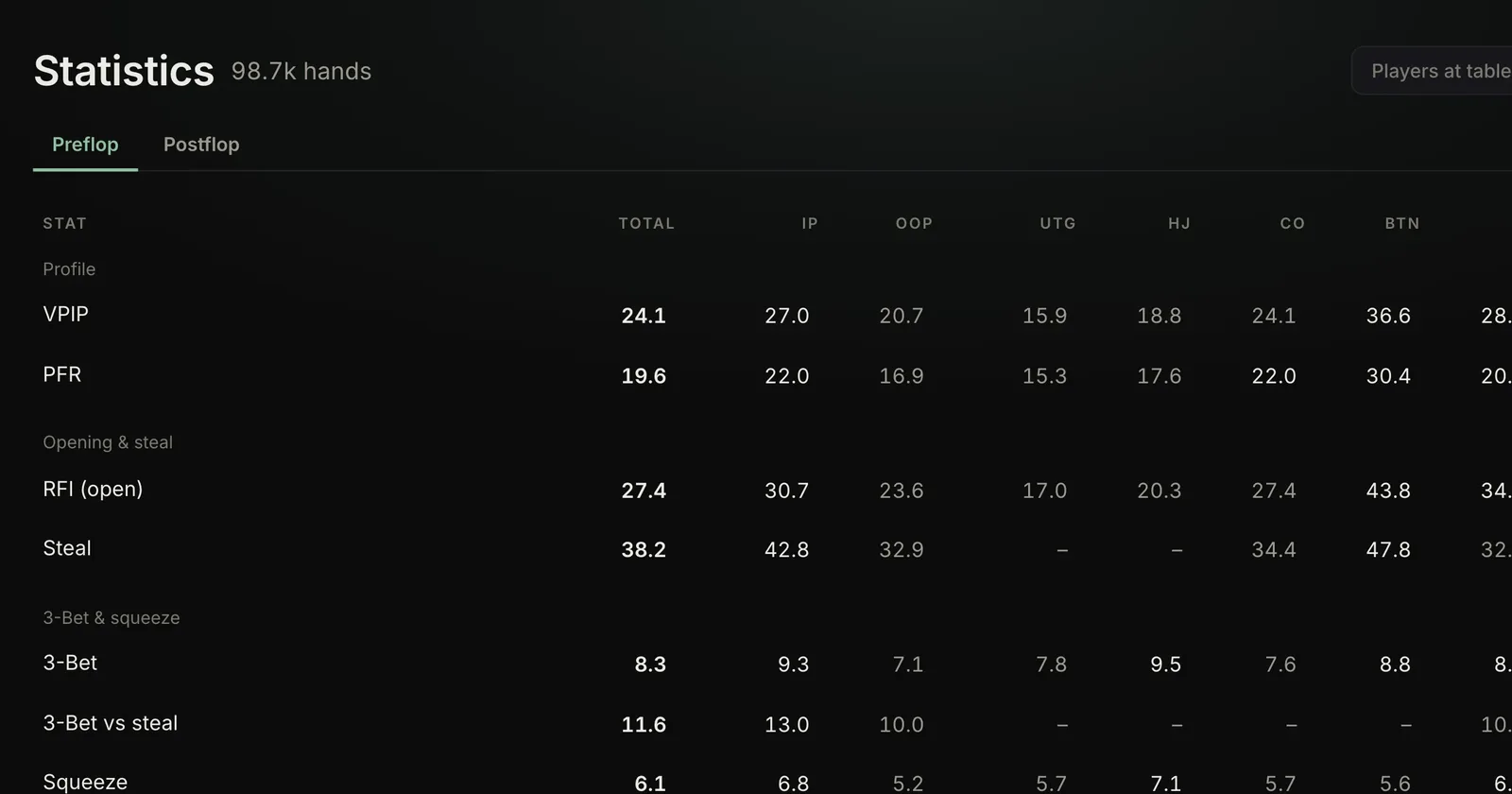
VPIP, PFR, 3-Bet, AF, WTSD and C-bet: Poker Stats Explained, With Reference Values
A poker tracker gives you dozens of numbers. Eight of them are enough to describe most of a player: VPIP, PFR, 3-Bet, AF, WTSD, W$SD, C-bet and Fold to C-bet. They are also the numbers you find by default on almost every HUD.
This article defines them one by one, gives their formula, then offers reference values by profile (nit, TAG, LAG, fish) for 6-max cash games. It ends with how to read these stats together, because a single number on its own says very little. If you are looking for the GrindLab page that shows these numbers for your own hands, reading your poker stats in GrindLab walks through it.
Why these stats exist
In poker you almost never see your opponents' cards. What you see are their actions, hand after hand. A stat turns those actions into a frequency: out of all the times this player could do X, how often did they do it?
A frequency has two virtues. It compares from one player to another, and it compares to a norm. The gap from the norm is what matters: a player who raises twice as often as average must have a weaker than average range when they raise. That is the starting point of all exploitative play.
Every stat has a numerator (what the player did) and a denominator (the opportunities to do it). The denominator is the part people forget, and it is what explains why some stats become reliable quickly and others very slowly.
Preflop stats
VPIP: Voluntarily Put money In Pot
Formula: hands where the player voluntarily called or raised preflop ÷ hands where they had a preflop decision.
Posting the small or big blind is not voluntary. A big blind that checks behind limpers does not count toward VPIP, and neither does a walk. Calling an open, limping, raising or shoving does.
VPIP measures how wide a player is. It is the first stat to look at and the fastest to settle: a player has a preflop decision every hand, so the denominator grows with every deal.
PFR: Pre-Flop Raise
Formula: hands where the player raised preflop ÷ hands where they had a preflop decision.
PFR counts the open, the 3-bet, the 4-bet and the preflop shove. It does not count a call. PFR is therefore always lower than or equal to VPIP.
The VPIP-PFR gap, the hidden stat
The gap between the two numbers is often worth more than either one. It measures the share of passive calls:
| VPIP-PFR gap | Reading |
|---|---|
| 2 to 5 points | Aggressive player: almost always enters by raising |
| 5 to 8 points | Standard regular: some calls in position and from the blinds |
| 10 to 15 points | Passive tendency: calls a lot of opens |
| more than 15 points | Calling station or passive fish |
A 24/20 and a 24/8 have the same VPIP and opposite styles. The first puts you under pressure; the second lets you take the initiative and pays off too much.
3-Bet
Formula: 3-bets ÷ 3-bet opportunities.
A 3-bet opportunity is a spot with exactly one raise in front of the player, where they can still raise. Facing a 3-bet already in place is not a 3-bet opportunity. Facing an all-in open is not one either. That is why 3-Bet needs more hands than VPIP: there is not an opportunity every hand.
Benchmark: between 6 and 10% in 6-max cash for a regular. Below 4%, a 3-bet is almost always value. Above 12%, the range has to contain bluffs. The 3-bet poker guide covers how to build that range.
Two stats often sit next to it on a HUD: Fold to 3-Bet (how often a player gives up their open facing a 3-bet) and 4-Bet. A Fold to 3-Bet above 65% is an invitation to 3-bet wider against that player.
Postflop stats
C-bet (continuation bet)
Formula: flop c-bets ÷ c-bet opportunities.
The player must have been the last preflop raiser and be first to bet on a flop where nobody bet before them. Trackers often split the stat by turn and river (2nd and 3rd barrel) and separate single-raised pots (SRP) from 3-bet pots, where frequencies are completely different. The c-bet poker guide explains the strategy behind these numbers.
Fold to C-bet
Formula: folds facing a c-bet ÷ times the player faced a c-bet.
This is the most useful defensive stat. A high Fold to C-bet, above 55%, makes small c-bets profitable with any two cards. A low Fold to C-bet, below 35%, signals a player who calls too much: c-bet more for value and far less as a bluff.
AF and AFq: postflop aggression
Two ways of measuring aggression coexist:
- AF (Aggression Factor) = (bets + raises) ÷ calls, postflop. It is not a percentage: an AF of 2.5 means 2.5 aggressive actions per call. It ignores folds and is undefined if the player never called.
- AFq (Aggression Frequency) = (bets + raises) ÷ (bets + raises + calls + folds), postflop, as a percentage. Checks do not count. AFq is steadier because it includes folds.
An AF below 1.5 describes a player who calls far more than they bet. An AF above 4 describes a player who bets and raises very often, so with a lot of bluffs.
WTSD: Went To ShowDown
Formula: hands that went to showdown ÷ hands where the player saw the flop.
WTSD measures stubbornness. Around 26 to 30% for a regular. Above 35%, the player goes to the end too often with medium hands: stop bluffing them on the river. Below 22%, they give up too early: multi-street pressure pays.
W$SD: Won money at ShowDown
Formula: showdowns won ÷ showdowns.
W$SD reads together with WTSD. High WTSD and low W$SD is the signature of a player who calls too much. Low WTSD and high W$SD is a player who only reaches showdown with the top of their range, so a player you can bluff more.
Reference values by profile (6-max cash)
The table below uses the preflop bands from the poker player types article and extends them postflop. These are ballpark values seen in 6-max cash games at low and mid stakes, not exact thresholds: room, stakes and rake shift them.
| Profile | VPIP | PFR | 3-Bet | AF | WTSD | W$SD | Flop C-bet | Fold to C-bet |
|---|---|---|---|---|---|---|---|---|
| Nit | 12-17% | 10-15% | 2-4% | 1.5-2.5 | 22-26% | 52-58% | 50-65% | 50-60% |
| TAG | 21-26% | 17-22% | 6-9% | 2.5-3.5 | 26-30% | 50-55% | 55-70% | 40-50% |
| LAG | 28-35% | 23-30% | 9-14% | 3-4.5 | 27-32% | 48-53% | 60-75% | 35-45% |
| Fish (passive, calling station) | 30-55% | 5-15% | 1-4% | below 1.5 | 35-45% | 44-50% | 30-50% | 25-35% |
For AFq, count roughly 30 to 40% for a nit, 40 to 50% for a TAG, 50 to 60% for a LAG and 20 to 35% for a passive fish.
The opening ranges that produce a TAG VPIP are visible in the preflop range charts: a UTG open of about 15% and a button open of about 45% give, once blinds and calls are added, an overall VPIP in the 21 to 26% band.
How many hands before you trust a stat
A stat without a sample is noise. The number of hands you need depends on the denominator: the rarer the opportunity, the more hands it takes.
| Stat | Hands for an exploitable read |
|---|---|
| VPIP | 50-100 |
| PFR | 50-100 |
| 3-Bet | 200-300 |
| Fold to C-bet | 300-500 |
| Postflop AF | 500-1,000 |
| WTSD and W$SD | more than 1,000 |
Over 30 hands, a 40% VPIP can come from a good run of cards. Over 300 hands, it is a profile. Most HUDs flag this visually: in GrindLab, a number resting on fewer than 10 opportunities shows in grey.
The same logic applies to your own stats on a bigger scale: your winrate in bb/100 needs tens of thousands of hands before it means anything, while your VPIP by position reads after a few thousand.
Reading stats together: five typical combinations
A single number does not describe a player. Here are five combinations that come up all the time, with the matching adjustment.
- VPIP 45 / PFR 8 / WTSD 40%: calling station. Value bet thin and big over three streets, never bluff the river.
- VPIP 14 / PFR 12 / 3-Bet 3%: nit. Steal their blinds relentlessly, fold medium hands to their 3-bet.
- VPIP 24 / PFR 20 / 3-Bet 8% / Fold to C-bet 45%: standard TAG. No obvious exploit: play your baseline and look for a subtler leak.
- VPIP 32 / PFR 27 / 3-Bet 13% / AF 4: LAG. Widen your value 4-bets, call their barrels more often with bluff catchers.
- Fold to C-bet 65% / WTSD 21%: a player who gives up too much. C-bet small and often, double barrel on turns that change the board.
These reads are the whole point of a HUD. Poker HUD explained covers how to display and read them at the table, and GrindLab's HUD shows how it does it on Winamax.
Traps to avoid
- Mixing formats. A heads-up VPIP and a full ring VPIP do not compare. A good tracker separates cash, tournaments and Spins, and also separates the number of players at the table.
- Mixing pot types. A c-bet in a 3-bet pot and a c-bet in a single-raised pot do not follow the same frequencies.
- Forgetting the denominator. A 20% 3-Bet over 15 opportunities says nothing.
- Treating a norm as a goal. The bands in the table describe profiles, not a target. Your best VPIP depends on your opponents.
- Transposing to tournaments. Short stacks, ICM and antes change everything. Winrate reads differently there too.
Where to see these stats on your own hands
To compute these frequencies you need a tracker that reads your hand histories. GrindLab Tracker, free on Windows and macOS, imports your hands automatically and computes these stats by format (cash, tournament, Spin) and by table size (heads-up, 3-max, 4 to 6 players, 7 players and more). Every number is compared with your field, meaning the opponents you have played in the same context.
The Free plan shows seven of these stats over the last 30 days (VPIP, PFR, 3-Bet, C-Bet, Fold to C-Bet, WTSD, W$SD). The Grinder plan opens every stat, by position and by street, plus the HUD on Winamax; details are on the pricing page. The Statistics chapter of the guide gives the exact definition of each row.
Once you have your numbers, the logical next step is to find where they drift from the norm: that is the method in how to find poker leaks.
Conclusion
Eight stats are enough to describe a player: VPIP and PFR for width and preflop aggression, 3-Bet for pressure on opens, C-bet and Fold to C-bet for the first postflop duel, AF for overall aggression, and the WTSD / W$SD pair for showdown behaviour.
Keep three habits: always look at the VPIP-PFR gap, check the sample before concluding, and compare a number within the same format and the same number of players. Download the free poker tracker to see these eight numbers on your own hands.