Poker Starting Hands: Which Ones to Play
The most frequent decision in poker is also the simplest: play or fold before the flop. That is where most beginners lose their money, not by misplaying big hands, but by playing too many mediocre ones.
This guide covers the categories of starting hands, their exact equities, and above all how position changes the value of each hand. For the basics of the game, see how to play poker and the poker hand rankings first.
169 hands, 1,326 combinations
Two cards out of 52 give 1,326 possible combinations. Grouping the ones that play the same (A♠ K♠ and A♥ K♥, for example) gives 169 distinct hands.
| Type | Notation | Distinct hands | Combinations per hand |
|---|---|---|---|
| Pairs | AA, 77, 22 | 13 | 6 |
| Suited | AKs, 76s | 78 | 4 |
| Offsuit | AKo, 76o | 78 | 12 |
The notation is universal: s means suited (same suit), o means offsuit (different suits). An offsuit hand has three times as many combinations as a suited one, which matters a lot when you estimate an opponent's range. See poker combinatorics.
Starting hand categories
Premium pairs: AA, KK, QQ
The best hands in the game. Always raise, and 3-bet when facing a raise. AA is the favorite against any other hand preflop.
Big hands: JJ, TT, AK, AQ
Very strong, but more vulnerable. AK wins many pots preflop, but only pairs on the flop about 32.4% of the time. JJ and TT fear overcards: on the flop, at least one card higher than a jack shows up most of the time.
Broadways: KQ, KJ, QJ, AJ, AT
Two cards ten or higher. Suited, they are playable from most positions. Offsuit, they become dangerous in early position: they are often dominated, meaning they share a card with a better opponent hand (KJ against AK, AJ against AK).
Medium and small pairs: 99 to 22
Their main value is flopping a set. With a pocket pair, you flop a set 11.8% of the time (about 7.5 to 1). They are profitable when stacks are deep.
Suited aces: A5s to A2s, A9s to A6s
They can make the nut flush, and the small ones (A5s to A2s) add a possible wheel straight. They are excellent hands to open in late position and to 3-bet as bluffs, because the ace reduces your opponent's AA and AK combinations.
Suited connectors and gappers: 98s, 76s, 54s, T8s
Speculative hands: they rarely hit hard, but when they do (straight, flush, two pair), they often win big, well-disguised pots. Play them in position, with deep stacks.
Hands to avoid
Weak, unconnected offsuit hands (K7o, Q5o, J3o, 83o) lose money in the long run from almost every position, except sometimes as blind steals from the button or small blind.
Exact preflop equities
These matchups were computed over every possible board (1,712,304 boards per matchup). They show why some hands are stronger than they look, and others weaker.
| Matchup | Equity of the first hand | Typical situation |
|---|---|---|
| AA vs KK | about 82% | Pair against a lower pair |
| AA vs JTs | 78.3% | Premium pair against a suited connector |
| KK vs A7o | 71.1% | Pair against one overcard |
| AKo vs AQo | 74.0% | Domination |
| AKo vs JTo | 62.6% | Two overcards against two lower cards |
| AQo vs KJo | 62.6% | High cards, no domination |
| AKo vs QQ | 42.8% | Unfavorable "coin flip" |
| AKs vs QQ | 46.2% | Coin flip, suitedness adds about 3 points |
| AKo vs 22 | 47.0% | Coin flip against a small pair |
| 77 vs AKo | 55.0% | Medium pair against two overcards |
| JTs vs AKo | 41.2% | Speculative hand against high cards |
Three lessons:
- Domination is expensive. AQ against AK has only 26% equity, barely more than a hand with a single live card.
- Being suited is worth a few points, not a transformation: AKs gains about 3 points against QQ compared to AKo.
- A "coin flip" is not exactly 50/50: a pair against two overcards is a slight favorite.
You can test any matchup, or a hand against a whole range, with the free poker equity calculator.
Position changes the value of hands
The same hand is not worth the same from every seat. The earlier you act, the more players remain behind you who may hold a strong hand, and the more likely you are to play out of position. Each seat is explained in our guide to poker positions.
Opening benchmarks for 6-max cash games at 100 big blinds, consistent with our poker open ranges by position:
| Position | Share of hands opened | Examples of hands added |
|---|---|---|
| UTG | about 13% | All pairs, all suited aces, suited broadways, AJo+, KQo |
| HJ | about 17% | ATo, KJo, 54s |
| CO | about 26% | A9o, KTo, QJo, K9s, J9s |
| BTN | about 45% | Almost every king, many queens, offsuit broadways |
| SB | about 35% as raises | Close to the button, slightly tighter |
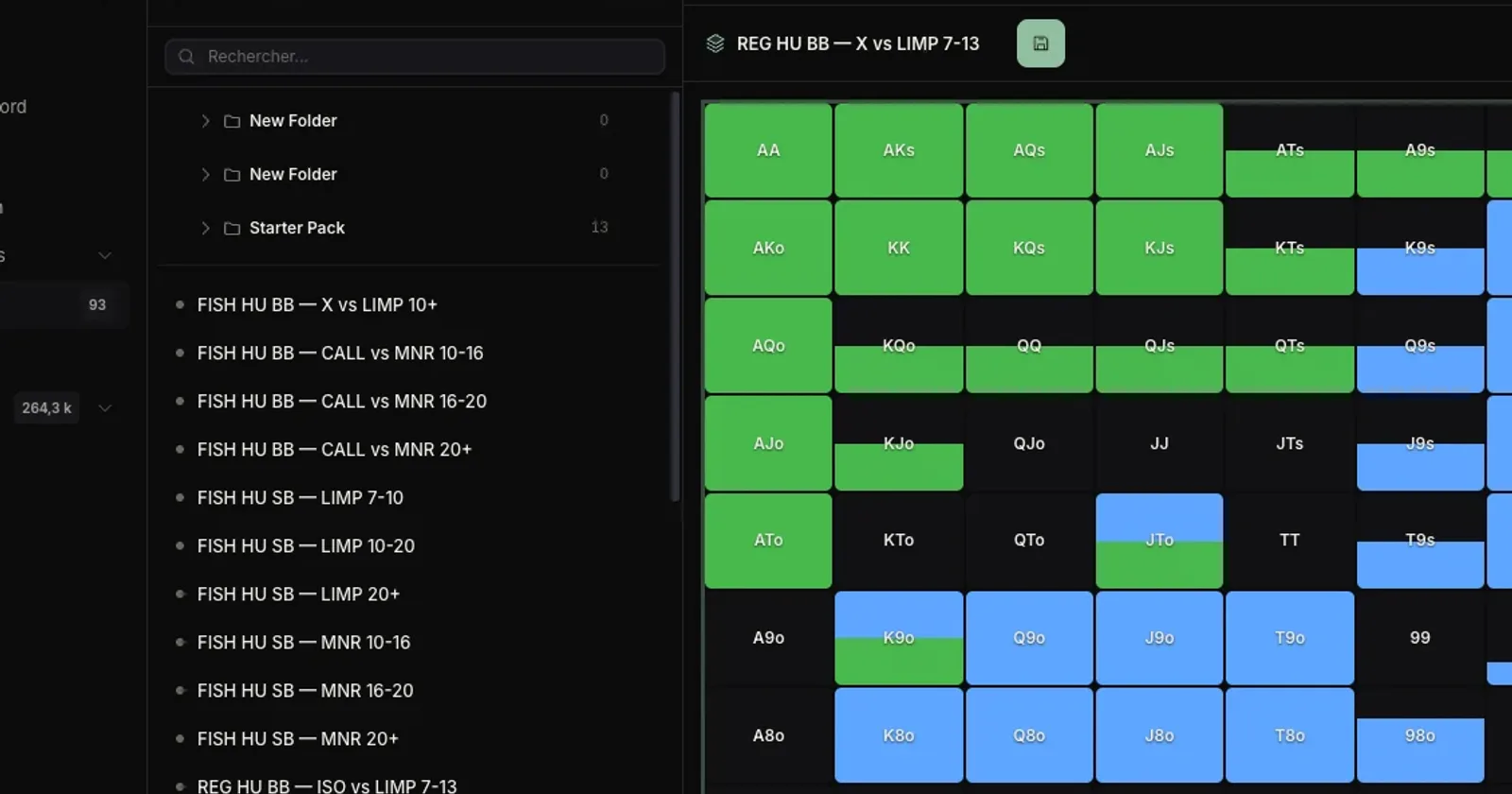
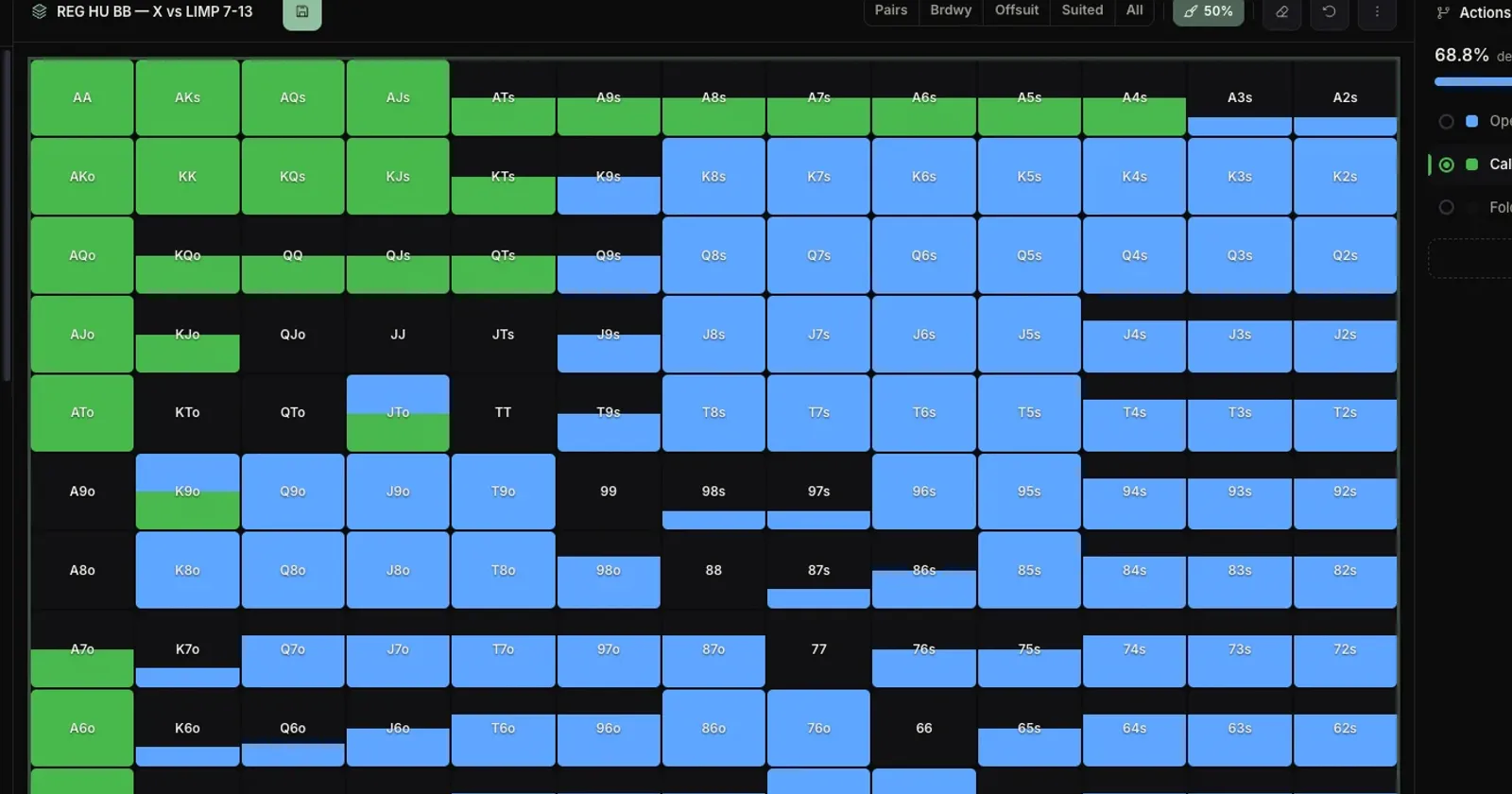
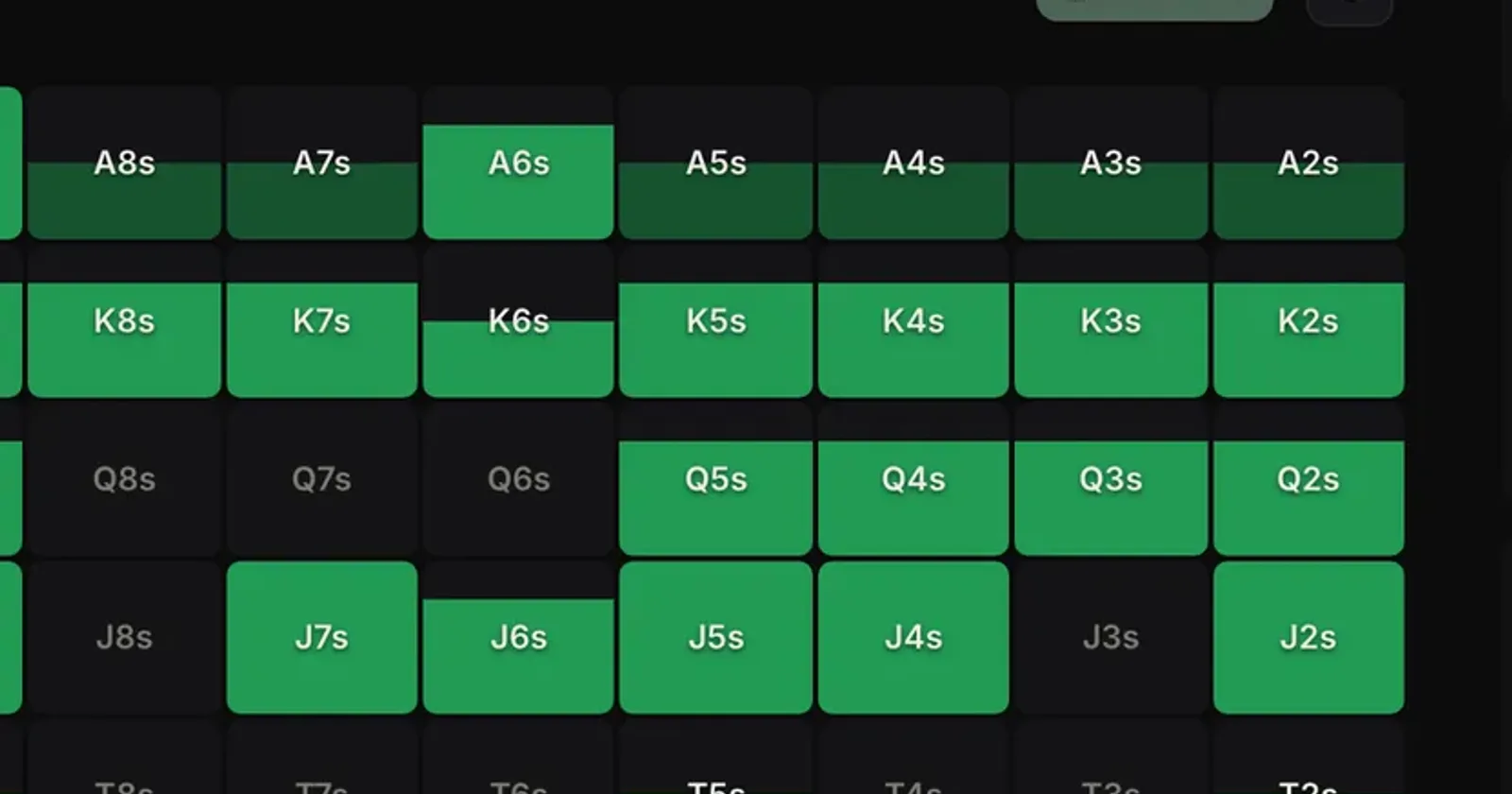
To see the full grids, suit by suit, open the preflop range charts. To understand how these ranges are built and adapted, read our guide on how to build poker ranges.
Open, call or 3-bet
Your starting hand choice also depends on the action in front of you.
- Nobody has opened: raise or fold. Open-limping (just calling the big blind) is almost always worse in modern cash games.
- Someone has opened: your range tightens. You call with hands that play well postflop in position, and 3-bet your best hands plus a few well-chosen bluffs. See the 3-bet in poker.
- You face a 3-bet: you only continue with a reduced part of your opening range. See facing a 3-bet.
- You are in the big blind: you get a discount and must defend wider, see defending the big blind.
Cash games or tournaments: what changes
In cash games, stacks usually stay deep (100 big blinds and more). Speculative hands (small pairs, suited connectors) gain value, because they can win big pots when they hit.
In tournaments, stacks shrink as blinds rise. High cards gain value, speculative hands lose it. Below fifteen or so big blinds, the game often comes down to shoving or folding: see push or fold and the free push fold charts.
The most common starting hand mistakes
1. Playing too many hands. The top cause of losses for beginners. If you see more than 30% of flops in 6-max, your range is probably too wide.
2. Overrating suited hands. Q4s is not a good hand just because it is suited.
3. Calling raises with dominated hands. KJo or AT against a UTG raise is often dominated.
4. Playing small pairs without depth. With a short stack, flopping a set does not pay enough to make up for the times you miss.
5. Ignoring position. The same hand can be a standard open on the button and a clear fold UTG.
A simple plan for beginners
If you are starting out, there is no need to memorize 169 hands at once. Progress in three steps.
| Step | What you play | Goal |
|---|---|---|
| 1. Tight base | Pairs 77+, AJ+, KQ, plus all pairs on the button | Avoid dominated hands, learn to play big hands |
| 2. Position | Add suited aces and suited broadways from the cutoff and button | Use position, steal the blinds |
| 3. Full ranges | Follow the range charts by position | Play a solid, consistent strategy |
Move to the next step once you play the previous one without hesitation. At each step, review a sample of your hands after the session: for every hand you played, ask whether it belonged to your range for that seat, and whether you would open it again. That review takes a few minutes and quickly exposes the hands you play out of habit rather than by choice. This plan leaves a margin: a step 1 that is slightly too tight costs far less than opening too wide out of position.
Measure what you really play
You think you play 22% of your hands? The real numbers are often different. Two stats measure it: VPIP (the share of hands where you voluntarily put money in the pot) and PFR (the share of hands where you raise preflop). The GrindLab Tracker, free with no hand limit, computes these stats from your imported hand histories.
Key takeaways
- 169 distinct hands, 1,326 combinations: 6 per pair, 4 per suited hand, 12 per offsuit hand.
- The best hands: AA, KK, QQ, AK, JJ. AA beats KK about 82% of the time.
- Domination is the big danger of offsuit hands: AQ against AK has only 26% equity.
- Being suited adds about 3 points of equity, no more.
- Widen your opens as you get closer to the button, and tighten up facing raises.