PKO Strategy: How to Play Progressive Knockout Tournaments
Progressive Knockout tournaments changed the way all-ins are played. In a classic MTT, you make money by climbing the payout ladder. In a PKO, you also make money with every elimination, immediately. That extra reward shifts almost every all-in decision: some folds become calls, and some marginal shoves become obvious.
This guide explains the bounty mechanics, how to convert a bounty into chips, how to adjust your calls and shoves, and the cases where the bounty changes nothing. For hands-on use in the tool, see our guide PKO and bounty in the Lab. For the big picture across formats, see our poker tournament strategy guide.
How the progressive bounty works
In a PKO, the buy-in is split into three parts: the regular prize pool, each player's starting bounty, and the rake. In most PKOs, the prize pool and the bounties split the buy-in evenly, rake aside. Check each tournament's rules, as the split can vary.
When you knock a player out:
- half of their bounty is paid to you in cash, right away;
- the other half is added to your own bounty, part of which the player who eventually knocks you out will collect.
Two consequences shape the whole format:
- Eliminations have immediate value, independent of your final finish.
- Bounties grow over time. A player who has knocked out many opponents carries a big bounty and becomes a target.
Converting a bounty into chips
To compare a bounty with a pot, you need both in the same unit. The usual method, as a first approximation:
chip value = cash value of the bounty ÷ share of the buy-in going to the prize pool × starting stack
Example: a 10 € PKO, with 5 € to the prize pool and a 5 € starting bounty (rake aside), and a starting stack of 20,000 chips. Each euro of prize pool is therefore worth about 4,000 chips.
- Knocking out a player who still carries their starting bounty pays you 2.50 € in cash, or about 10,000 chips, half a starting stack.
- The 2.50 € added to your own bounty also has value, but it is uncertain: you only collect it if you knock out more players later. Most players count it only partially.
A mid-tournament example
Take the same 10 € PKO. Two hours later, blinds are at 500 / 1,000, and one opponent has knocked out several players: their displayed bounty is worth 10 €.
- The cash half of their bounty is worth 5 €, or about 20,000 chips.
- With a 1,000 big blind, that is 20 big blinds.
In other words, knocking them out pays you the equivalent of 20 big blinds on top of the pot. If their stack is only 15 big blinds, the bounty is worth more than their chips. That explains the very wide calls you see in PKOs against players with big bounties: they are not mistakes, they follow the math.
Conversely, a player still carrying their starting bounty (5 €, of which 2.50 € is paid out) is worth only 10,000 chips, or 10 big blinds at the same level. Look at every opponent's displayed bounty, not just their stack: two identical stacks can have very different values.
This conversion remains an approximation. It assumes chips have linear value, which stops being true near the bubble and at the final table, where ICM comes into play.
The effect on your calls
This is where the bounty changes the most decisions.
Example: an opponent shoves 10 big blinds from the button, the small blind folds, you are in the big blind and you cover them. Without antes, you must add 9 big blinds for a final pot of 20.5 big blinds.
| Situation | Calculation | Required equity |
|---|---|---|
| No bounty | 9 ÷ 20.5 | 43.9% |
| Bounty worth 5 big blinds | 9 ÷ 25.5 | 35.3% |
| Bounty worth 10 big blinds | 9 ÷ 30.5 | 29.5% |
A bounty worth 5 big blinds removes more than 8 points of required equity. Against a wide shove, that brings hands like weak aces, medium kings or small pairs into your calling range, hands that would be folds in a classic MTT.
The calculation rests on pot odds: the bounty is simply added to what you win when you take the pot at showdown. You can check your hand's equity against the opponent's shoving range with our free poker equity calculator.
The coverage rule
The bounty only counts if you cover the opponent. If they have more chips than you, winning the hand does not eliminate them, and their bounty stays on their head. In that case, decide as you would in a classic MTT, with the added risk of losing your own bounty.
It is the most widespread mistake in the format: calling off a stack "for the bounty" against a player who covers you.
The rule also works in reverse when several players are involved. In a multiway all-in, only the player who wins the pot and covers the busted player collects the bounty. If a side pot exists, the bounty goes to whoever eliminates the player, which is the winner of the pot that player was part of. Before calling in a multiway spot, check which stacks you actually cover.
The effect on your shoves and opens
The bounty also changes how others play against you.
Players who cover you call wider. Your bounty lowers the equity they need. Your fold equity drops, so your shoves need to be a little stronger against them.
Players you cover call as in a classic MTT. They do not win your bounty by calling, since they cannot knock you out.
Short stacks become targets. A short stack often carries a bounty that is large relative to their chips. Big stacks open and isolate wider to go after it. That is your cue to shove tighter when you are short, since you will be called more often, and to favor value.
| Your situation | Adjustment |
|---|---|
| You cover the opponent who shoves | Call wider according to their bounty |
| The opponent covers you | Classic MTT decision, no bounty |
| You are short with a big bounty | Expect wider calls, shove more value |
| You are the chip leader | Isolate the short stacks with big bounties |
Our push fold charts give reference ranges without bounties: in a PKO, start from those ranges, then widen your calls when you cover and tighten your shoves slightly against players who cover you.
PKO and ICM: the combination
The bounty does not erase ICM, it softens it. Part of the tournament's money is paid out immediately with each elimination, which reduces the share subject to ICM. In practice:
- Early and mid tournament, the bounty dominates: play all-ins more aggressively than in a classic MTT.
- On the bubble, ICM pressure returns, but the bounty partly offsets the risk. Calls stay wider than in a classic MTT, but narrower than early in a PKO. See our poker bubble strategy guide.
- At the final table, the remaining players' bounties are often large, and so are the pay jumps. Both effects combine: every elimination pays the bounty and gives everyone a pay jump. See our poker final table strategy guide.
Classic PKO mistakes
1. Counting the bounty of a player who covers you. It cannot be won on that hand.
2. Counting the whole bounty as cash. Only half is paid out immediately. The other half has an uncertain future value.
3. Playing a PKO like a classic MTT. Folding profitable calls against short stacks leaves the bounty money to others.
4. Shoving too wide while carrying a big bounty. You will be called more often than you think.
5. Forgetting ICM late in the tournament. The bounty softens the pressure, it does not remove it.
Analyzing your PKO spots with GrindLab
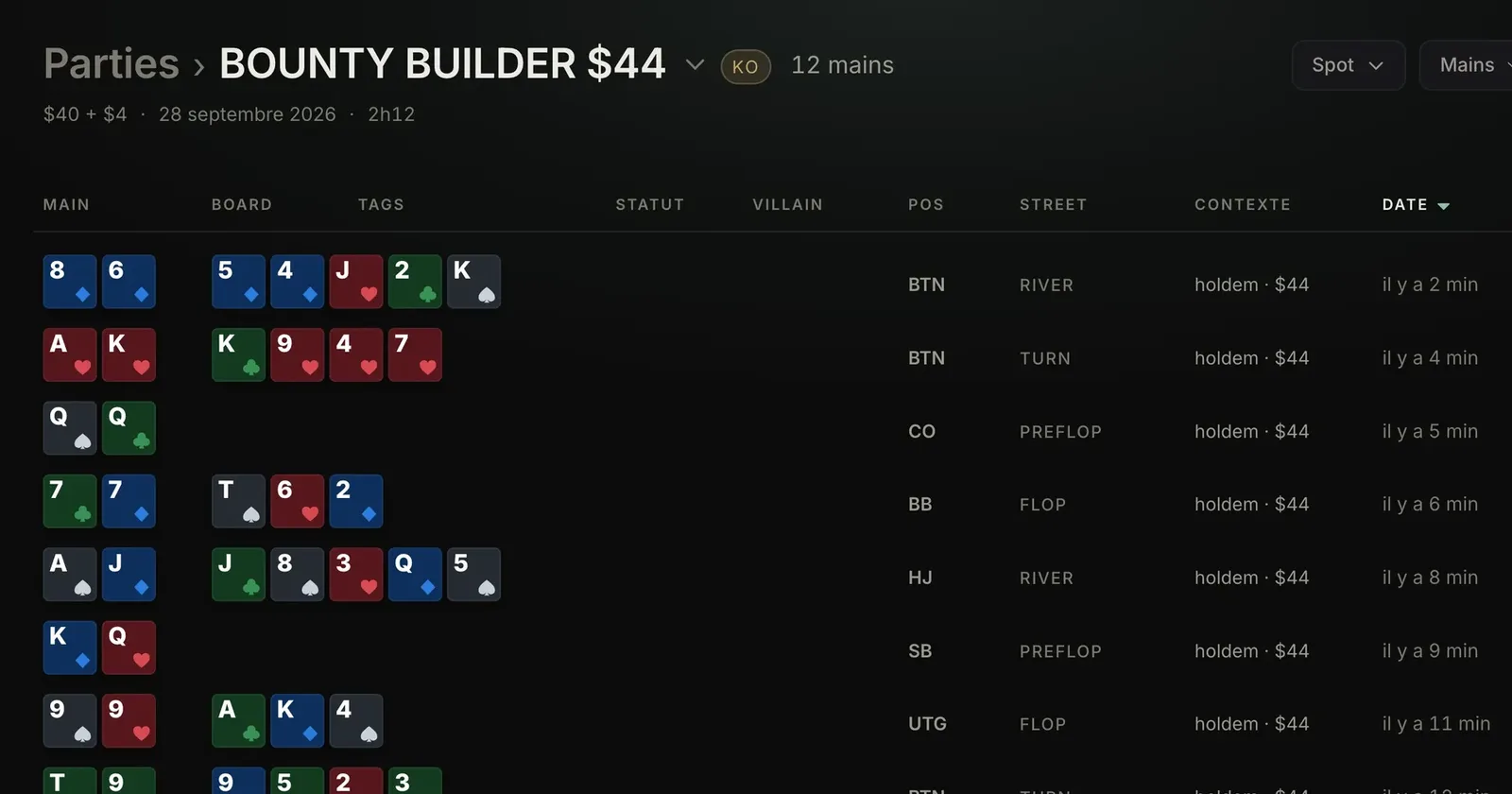
- Find your all-in PKO hands with the GrindLab Tracker, which imports your hand histories and tournament results. See also the guide to tracking your tournament results.
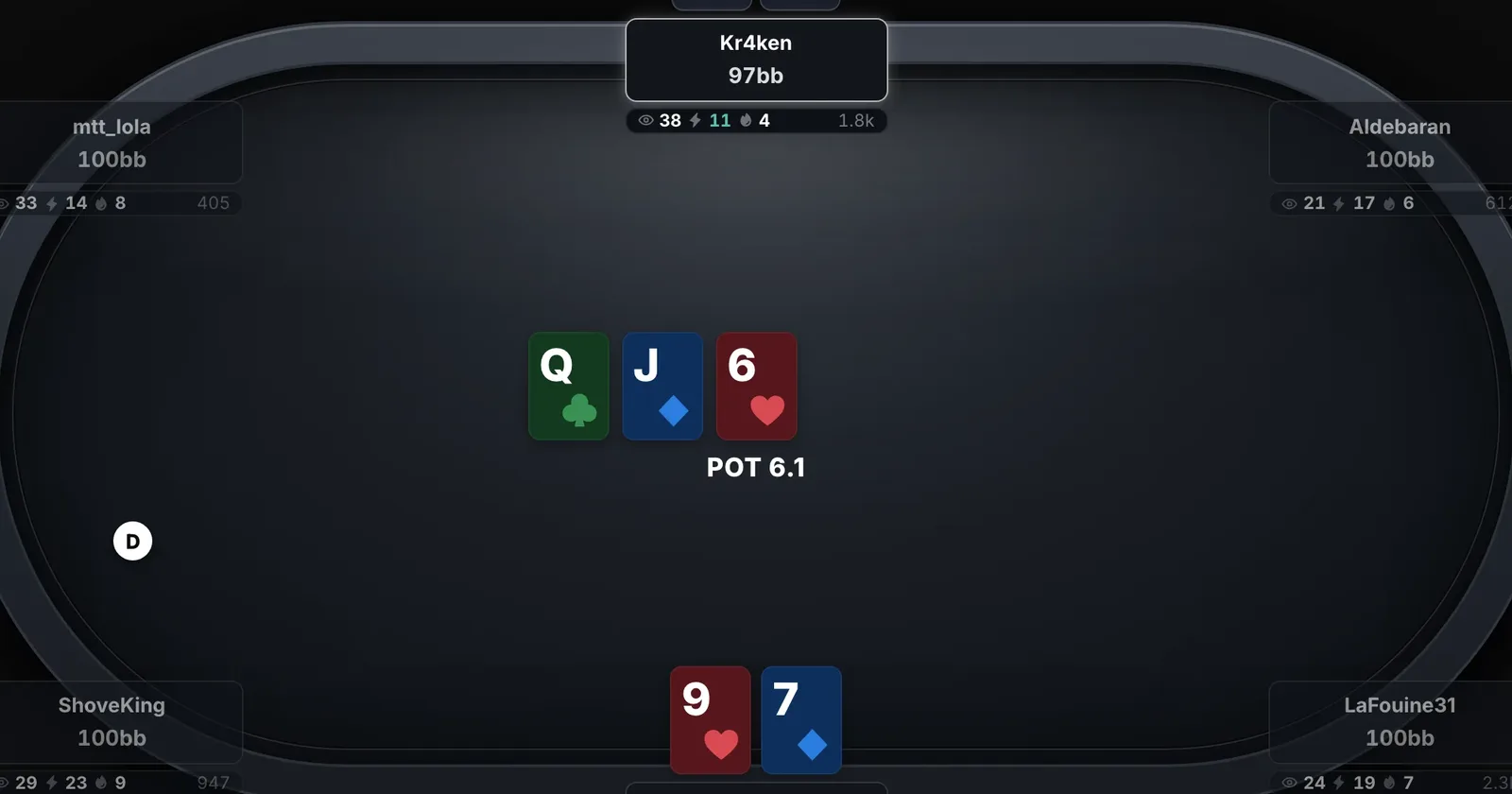
- Replay the hand in the Lab in MTT format. When the opponent is all in, enter their bounty in big blinds: the verdict's EV adds the bounty to the showdown win.
- Compare with and without the bounty. Set the bounty to 0 to measure what it changes. On a marginal spot, it often flips the verdict.
- Add ICM mentally near the bubble: the Lab has no built-in ICM model. The ICM calculator gives you the order of magnitude.
The settings are detailed in our guide PKO and bounty in the Lab.
Calculate hand equity, pot odds, and compare ranges with GrindLab's free equity engine
Try it free →Key takeaways
- In a PKO, every elimination immediately pays half the opponent's bounty, and the other half grows yours.
- Convert the bounty into chips: half a starting bounty is worth about half a starting stack in an evenly split PKO.
- A bounty worth 5 big blinds moves a call's required equity from 43.9% to 35.3% in our example.
- The bounty only counts if you cover the opponent.
- ICM is softened, not removed: it returns on the bubble and at the final table.
To place PKOs among the other formats and phases of a tournament, read our poker tournament strategy guide.