
PKO and Bounty in the Lab: Configure, Model, Shove Correctly
Progressive Knockout tournaments have changed the way we shove. In a classic MTT, you shove when your chip-EV is positive. In a PKO, you shove when your cash-EV (bounty-EV) is positive — and that's often way wider because eliminating a player directly puts money in your pocket.
GrindLab now models bounty in the EV calc at the Lab. When villain is all-in and you win the showdown, you capture his bounty — the EV formula integrates this automatically. This article covers how to configure the bounty, how to read the post-modelling breakdown, and three concrete cases where bounty changes the decision.
The math: where bounty enters the EV formula
The general formula for a shove or all-in call in GrindLab:
EV = foldFrac × pot
   + (1 − foldFrac) × (eq × (pot + callAmount + bounty) − (1 − eq) × bet)
Bounty adds only in the showdown-win term — eq × (pot + callAmount + bounty). Three cases:
- Villain folds (probability
foldFrac) → no elimination → no bounty captured. You win the existing pot. - Villain calls and hero loses (probability
(1−foldFrac) × (1−eq)) → hero is the one getting eliminated. No capture for hero. (GrindLab doesn't model hero's bounty loss — see limits below.) - Villain calls and hero wins (probability
(1−foldFrac) × eq) → villain is eliminated. Hero captures the bounty.
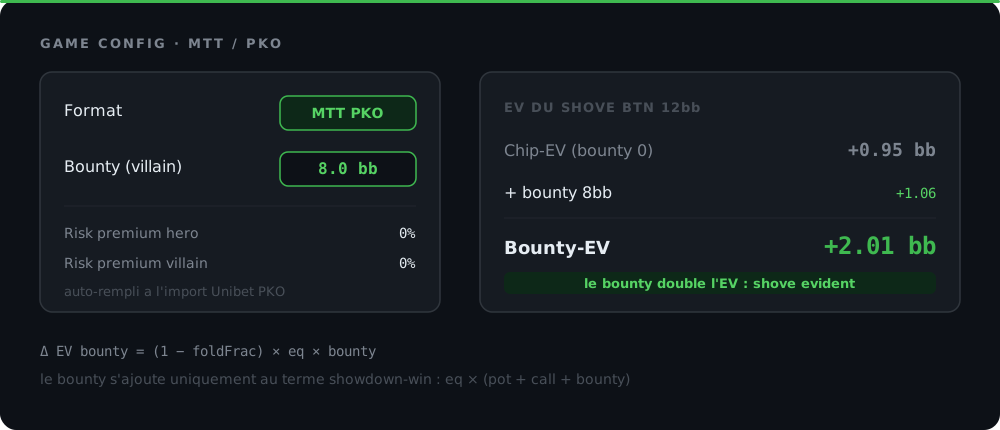
Impact in bb: Δ EV bounty = (1−foldFrac) × eq × bounty. Linear in bounty and proportional to equity — the more equitable you are, the more the bounty pays.
Concrete example: a marginal shove that becomes profitable
Typical PKO bubble setup:
- Effective stack: 12bb (you BTN vs villain BB who has an 8bb bounty)
- Pre-shove pot: 2.5bb (blinds + antes)
- You shove 12bb. Villain calls 35% of his range (rest folds).
- Your equity vs the calling range: 38%
Chip-EV (without bounty):
EV = 0.65 × 2.5 + 0.35 × (0.38 × (2.5 + 12) − 0.62 × 12)
   = 1.625 + 0.35 × (5.51 − 7.44)
   = 1.625 + 0.35 × (−1.93)
   = 1.625 − 0.676
   = +0.95bb
Marginally positive. Shove or fold?
Bounty-EV (with bounty 8bb):
EV = 0.65 × 2.5 + 0.35 × (0.38 × (2.5 + 12 + 8) − 0.62 × 12)
   = 1.625 + 0.35 × (0.38 × 22.5 − 7.44)
   = 1.625 + 0.35 × (8.55 − 7.44)
   = 1.625 + 0.388
   = +2.01bb
The shove goes from +0.95bb (marginal) to +2.01bb (very clear). The bounty doubles the EV. The decision is no longer marginal — it's an obvious shove.
That's exactly what you see in the Lab breakdown when you set the bounty correctly.
Configuring bounty in GrindLab
Via Unibet PKO import
If you import a hand from Unibet PKO, the player's initial bounty is extracted from the tournament header at parse time. It lands automatically in the spot's MTT config when you send to the Lab. Nothing to do manually.
Note: the extracted bounty is the bounty at the time of the hand, not the tournament's initial bounty. On Unibet, the hand history snapshots the current bounty on every hand — so if villain has already eliminated 3 players before your hand, his bounty is high and the parser captures it as is.
Via manual Game Config
In the Lab, open Game Config (gear top right):
- Format: MTT
- Bounty: value in bb (villain's current bounty in the spot)
You can also adjust other MTT parameters:
rpHeroVsVillain: ICM risk premium when hero faces a betrpVillainVsHero: ICM risk premium when villain faces a hero bet
The bounty is independent of ICM risk premium — both add into the EV calc (risk premium adjusts equity, bounty adds to showdown-win).
Reading the breakdown after bounty integration
The "EV breakdown" block in the tooltip next to the pill shows three rows:
| Row | Calc (with bounty) | Post-bounty change |
|---|---|---|
| EV vs fold range | foldFrac × pot | Unchanged — no bounty if villain folds |
| EV vs call range | (1−foldFrac) × (eq × (pot + callAmount + bounty) − (1−eq) × bet) | Increases by (1−foldFrac) × eq × bounty |
| Total | sum | Increases by (1−foldFrac) × eq × bounty |
To visualise the pure bounty edge: note total EV. Set bounty to 0 in config. Note new EV. The delta = what the bounty earns you on this specific shove.
Use cases: three concrete PKO spots
Spot 1: short BTN shove vs deep BB
You have 8bb at BTN. Villain BB has 80bb and a 5bb bounty. Preflop action: you push, he decides call/fold.
His call range vs a short BTN push is typically 25-30% in a classic MTT. In PKO, it widens to 40-45% — he has a strong incentive to KO you for your bounty (even if yours is small, it's free money). The breakdown shows your shove EV is positive wider than your chip-EV suggests — so your shove range can also widen.
Spot 2: all-in call vs short shove
You're BB with 50bb. A short stack BTN with 6bb shoves. His bounty is 4bb. You consider calling.
Without bounty: your standard call range vs a 6bb BTN push, ~30% of hands.
With bounty 4bb: Δ EV per call = eq × bounty. For hands with 50% equity, that's +2bb of free EV. Your call range can widen by ~10-15% more — all the hands that were marginal in chip-EV become profitable with the bounty.
The Lab breakdown tells you exactly where the threshold flips.
Spot 3: postflop shove with deep stack and bounty
You're CO with 60bb. Villain BB calls your 2.5bb open, flop. He has 50bb and a 12bb bounty (= he already KO'd several players before you). You consider a flop shove to realise your overpair equity + leverage the bounty.
The breakdown will show:
- Moderate
evFold(villain rarely folds to overshove) - Bounty-adjusted
evCall:eq × (pot + callAmount + 12)— the +12 makes all the difference
If you have 65% equity vs his calling range, the bounty earns you 0.6 × 0.65 × 12 ≈ 4.7bb more than without bounty. Turns a borderline polarization shove into an obvious one.
Model limits and assumptions
-
Hero's bounty not subtracted on loss: GrindLab only models capturing villain's bounty when hero wins. Losing hero's bounty (= when hero is eliminated and villain captures his bounty) is not subtracted because the config stores a single generic bounty value. On very marginal shoves where hero has a big bounty (mid-game), the calc slightly underestimates losses. Worth keeping in mind for PKO spots where hero is itself a significant bounty target.
-
Constant bounty in config: you set a single value for villain. If your spot involves several opponents with different bounties (multiway), the model uses the configured value as a proxy. For a precise multiway PKO spot, set the bounty to the largest (worst case) or the average depending on your angle.
-
No ICM modelling: bounty and ICM coexist in the config (separately adjustable risk premium). Risk premium affects equity, bounty adds to showdown. Both are independent — so you can model a PKO bubble spot with both bounty and high risk premium.
-
Showdown win = full bounty capture: the model assumes you capture 100% of villain's bounty if you win the showdown against an all-in villain. In real PKO, the bounty splits in two: 50% cash in your pocket, 50% adds to your own bounty. The model simplifies by treating your capture as "+bounty bb" — equivalent to assuming you value your own bounty at current value (correct heuristic if you have no plan to keep it long).
General PKO strategy
Three principles the EV breakdown confirms spot by spot:
-
Shove wider on short opposing stacks — their bounty is typically representative and their fold equity vs a push is high. Captured bounty + uncontested pot on fold = very +EV combo.
-
Call wider vs short shove with big bounty — any hand with reasonable equity (40%+) becomes profitable to call because bounty capture compensates the chip-EV loss of marginal hands.
-
Avoid all-in confrontations between two big stacks — high risk of losing your own bounty, limited gain from opposing bounty (small relative to your stack). The breakdown doesn't say it explicitly (missing hero bounty subtraction), but GTO PKO models confirm this heuristic.
Wrap-up
Bounty in a PKO isn't a detail — it's what radically changes shove and call ranges compared to a classic MTT. GrindLab integrates bounty into the Lab's EV calc, letting you quantify the bounty edge per spot.
Three habits to build:
- Set the correct bounty in Game Config as soon as you work a PKO spot — otherwise you systematically under-estimate your shove EVs.
- Compare EV with and without bounty to visualise the bounty-driven edge — that's your format-specific advantage.
- Widen your short shove and call vs short ranges — the breakdown math confirms it's mathematically justified.
Import a recent Unibet PKO session from My Hands, send a shove to the Lab, and look at the EV breakdown. The bounty is already integrated — you just need to read the number.
The method in 6 steps
Configure bounty in Game Config
In the Lab, open Game Config (gear icon top right). Select MTT format. The 'Bounty' field appears in bb. Enter villain's current bounty value. If you import an Unibet PKO hand, it's filled in automatically.
Verify villain is all-in in the spot
Bounty only kicks in when the Equity Verdict panel shows 'Shove +EV' or 'Shove −EV' (= all-in spot detected). If you're in a non-all-in spot, bounty is ignored in the calc even if set in the config — consistent since no one is being eliminated.
Read the post-bounty breakdown
Hover the (i) next to the EV pill. The 'EV vs call range' line now includes the bounty in its calc: eq × (pot + callAmount + bounty). The total directly reflects what you earn on average per shove, bounty included.
Compare with / without bounty to measure the PKO edge
Note the EV with bounty active. Set bounty to 0 in the config and watch the new EV. The difference quantifies the purely bounty-driven edge. On marginal shoves (chip-EV near 0), the delta can flip a −EV shove into +EV.
Adjust your calling range vs high bounty
Inverse: when you face a shove in PKO and consider calling, the bounty models what you gain from eliminating villain. Your call becomes more profitable than in pure chip-EV. PKO call ranges are notably wider than classic MTT ranges — the tool makes it visible.
Strategy: aggressive shoving on short stacks
General heuristic: the larger villain's bounty relative to the pot and your stake, the wider you can shove. GrindLab gives you the exact number spot by spot. Set up typical spots (BTN vs BB short, SB vs BB short, etc.) with various bounty values to calibrate your ranges.