
Smart Filters in the Lab: MDF, Polarize, Value, Cap — When to Use Which
Exploitative poker analysis comes down to one question: which combos does villain keep in his continuing range against my action? The more precisely you answer, the more your equity vs that continuing range reflects reality — and the more usable your computed EV becomes.
Doing this manually, combo by combo, takes ten minutes per spot. GrindLab's Smart Filters do it in one click from four strategically distinct presets. This article breaks down the math behind each one, explains when to use it, and shows how to read the resulting EV.
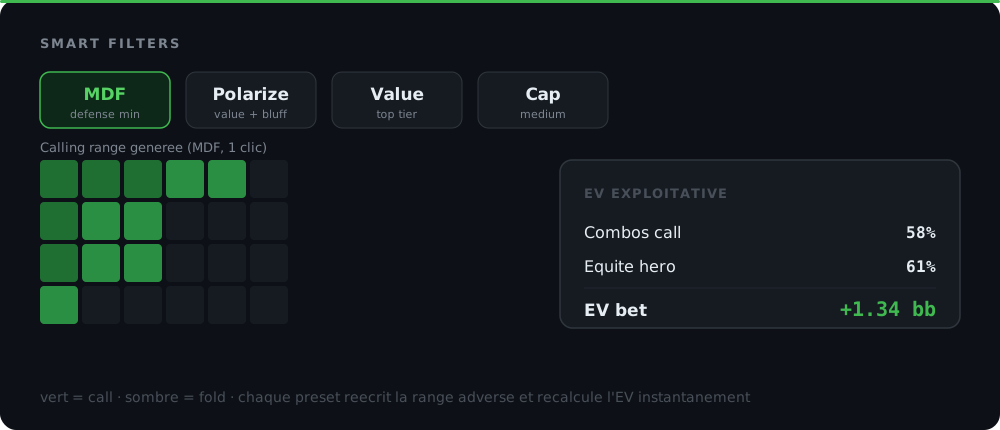
The four filters: semantics in 30 seconds
| Filter | What it keeps | What it removes | Typical use case |
|---|---|---|---|
| MDF | Top of range up to the minimum defence threshold | Combos below the threshold | Modelling a villain who defends optimally |
| Polarize | Top X% (value) + Bottom Y% (bluffs/semi-bluffs) | Medium hands | Modelling a villain who plays polarised (3bet/all-in aggressive) |
| Value | Top X% only (the strongest hands) | Everything else | Modelling a villain who only defends with value |
| Cap | Everything except top X% | The best hands (sets, flushes, nuts) | Modelling a capped calling range (no monsters) |
Each preset applies to the street-entry range (= the range when villain first enters this street, before your action). It's the baseline that prevents over-folding when chaining filters.
MDF: the GTO minimum defence threshold
Minimum Defense Frequency (MDF) is the percentage of his range villain must defend against a bet to prevent hero from profitably bluffing any two cards. The formula:
MDF = 1 − (bet / (pot + bet))
At 1/3 pot: MDF = 75%. At 1/2 pot: MDF = 67%. At pot: MDF = 50%. At 2× pot: MDF = 33%.
GrindLab's MDF Smart Filter computes the target MDF and keeps the top MDF% of villain's range by hand strength on the current board. The scoring uses rangeRelative — each combo is rated by its strength relative to the other combos in the range (not in absolute terms).
When to use it:
- You're modelling a solid (GTO-style) villain facing your bet or raise.
- You want to check whether your sizing extracts enough vs optimal defence.
- You're testing the EV of a bluff at sizing X: MDF gives the minimum theoretical fold% below which your bluff goes +EV.
Concrete case: you bet 2/3 pot. MDF = 60%. Apply the filter. If villain defends optimally, he keeps 60% of his range — typically his pairs, strong draws, overcards with backdoor. The EV you compute is the "vs GTO" EV. If you play against a solid reg, this is the baseline.
Note: the MDF scoring reflects each combo's equity vs your assumed betting range, not raw equity. A combo with 50% global equity but 30% vs your value range scores low — consistent with what a good player folds.
Polarize: value + bluffs, drop the medium
Polarize models a villain who defends with his best hands (value) and his worst (bluffs/semi-bluffs) — but not the medium. The popover has two thumbs:
- Top X%: the top portion kept as value (default 12%)
- Bottom Y%: the bottom portion kept as bluffs (default 8%)
Total removed = 100 − X − Y. At defaults, 80% of the range disappears, leaving 20% (12% top + 8% bottom).
When to use it:
- You're facing a check-raise or a 3bet/4bet — villain builds a polarised range by definition.
- You're modelling an aggressor who leverages his fold equity (small ball with air, value with monsters, little medium).
- You're testing the profitability of a bluff catch against this polarised range.
Concrete case: turn check-raise from villain. Apply Polarize 15/15. You keep his sets and straights (top 15%) + his weak draws and bluffs (bottom 15%). The medium (middle pair, weak top pair) disappears — he would have just called, not check-raised.
Subtlety: the "bottom" scoring rewards draws with blockers (Ax on a flush board, for example) — bottom 8% is not pure air, it's air with fold equity. More realistic than modelling villain as a random bluffer.
Value: top tier only
Value keeps the top X% of the range and removes everything else. It's the extreme case of the "tight passive" villain — he defends only with hands he considers ahead.
When to use it:
- You're modelling a nit who only calls with value.
- You're testing a thin value bet: if villain only has top 10%, your 50% global equity might drop to 35% vs his continuing range.
- You're verifying that a c-bet bluff truly has the expected fold equity — if villain only has top 20%, he folds 80%, your bluff is very profitable.
Concrete case: c-bet on a dry flop against a passive fish. Apply Value 15%. The continuing range = his overpairs and top pairs only. Your EV breakdown shows huge evFold (because he folds 85% of combos) and maybe negative evCall (because his range is very strong when he continues). Total = positive if fold equity dominates — typically the case with this villain profile.
Cap: removing the monsters
Cap is the inverse of Value: it removes the top X%. The remaining calling range structurally lacks nuts (sets, straights, top flushes). That's what's called a "capped range".
When to use it:
- Postflop after a preflop open/3bet where villain wouldn't have 4bet/all-in his very strongest hands preflop.
- Turn/river after a check from villain — he probably didn't slowplay a monster, so top of range is gone.
- Spots where villain has shown passive weakness (check-call two streets) — his range is probably uncapped.
Concrete case: river check from villain on an action board (two pair on flop, draw completed on turn). Apply Cap 8%. You remove his sets and flushes — he would have bet them for value. Your thin top-pair value bet suddenly becomes solidly +EV because his continuing range is capped to middle pair / busted draws.
Reading the EV after Apply: what changes in the breakdown
When you Apply a filter, two things change in the EV calc:
foldFrac(fold equity) increases — removed combos become excluded combos, assumed to fold to your next action.eq(equity vs calling range) changes — usually goes up if you remove hands that were beating you (MDF, Value); goes down if you remove bluffs (Polarize keeps bluffs).
The breakdown under the verdict (tooltip next to the EV pill) shows both branches:
evFold = foldFrac × potalways increases after Apply (unless you remove combos that weren't gonna fold)evCall = (1 − foldFrac) × (eq × (pot + callAmount) − (1 − eq) × bet)can go up or down depending on the mix
That's exactly what you want to compare: before filter = EV "vs full range" = naïve baseline. After filter = EV "vs filtered range" = what you'll actually earn if your model is right.
If the delta is massive (e.g. +1.5bb → +4bb after MDF), your sizing is very exploitative. If the delta is marginal, your sizing is already well-calibrated for the full range — good news, your edge is robust to imprecise fold% estimates.
Chaining filters: suggested order
You can apply multiple filters in sequence. Important: each Apply starts from the street-entry range, not the current range. So no risk of double-folding.
Suggested order for a fine exploit:
- MDF first — cuts the theoretical fold tail.
- Then Polarize if you know villain builds polarised on this kind of spot (turn check-raise, preflop 3bet).
- Cap last if villain has shown actions that uncap the range (passive check, classic line).
You can always Reset (icon next to the Smart Filters button) to start from scratch and compare.
Limits and caveats
-
Smart Filters don't replace population knowledge: they offer reasonable defaults but the right setting depends on the player pool. At 5NL Zoom, your "regular" villain folds way more than theoretical MDF. At 100NL high stakes, he defends better. Calibrate the sliders based on what you know.
-
Multiway: filters are disabled in multiway (3+ players). The "calling range" logic becomes ill-defined when several opponents are involved — each has their own defence threshold.
-
Preflop: filters mainly apply postflop. Preflop, the input is usually the GTO or exploitative open/3bet/4bet range — not a strength-based filter.
-
Free plan: Smart Filters are gated behind the Grinder subscription. On the free plan, you can deselect manually and use the category filters (pairs, draws, overcards) which remain free.
Wrap-up
Smart Filters are the tool that turns an analysis from "I estimate he folds 60%" into "here's the exact range he keeps if he defends 60% on this board". The difference is measurable: your computed EV moves from an approximation to a concrete exploitative value.
Three habits to build:
- Apply MDF as the GTO baseline when testing a new sizing — that's the "fair price" vs an optimal defender.
- Apply Polarize for villain actions that leverage fold equity (check-raise, 3bet) — consistent with their range structure.
- Read the post-Apply breakdown: if
evFoldexplodes, you're exploiting; ifevCallalso goes up, it's a value + fold equity spot → the ideal situation.
Open any spot in the GrindLab Lab and click "Smart Filters". Try Apply MDF, watch the EV change. That's the exploit in numbers.